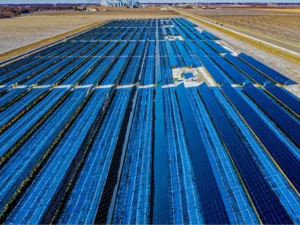
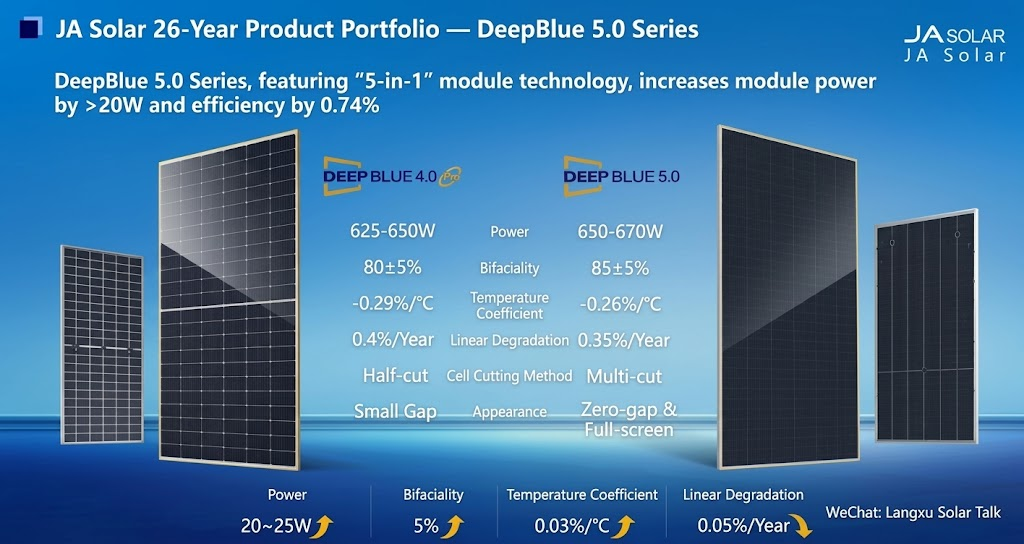
When I talk to customers about solar modules, power rating is usually one of the first things we discuss. But the more I learn about the technology, the more I realize that JA Solar DeepBlue 5.0 is worth looking at beyond its 640W+ power rating.
A solar module may look great on a datasheet, but how will it perform after years outdoors? What happens when part of the module is shaded? And for projects in the Middle East, how much do high temperatures and dust really matter?
These are the questions I think are worth asking before choosing a module.
1. What Makes Three-Cut Cell Technology Interesting?
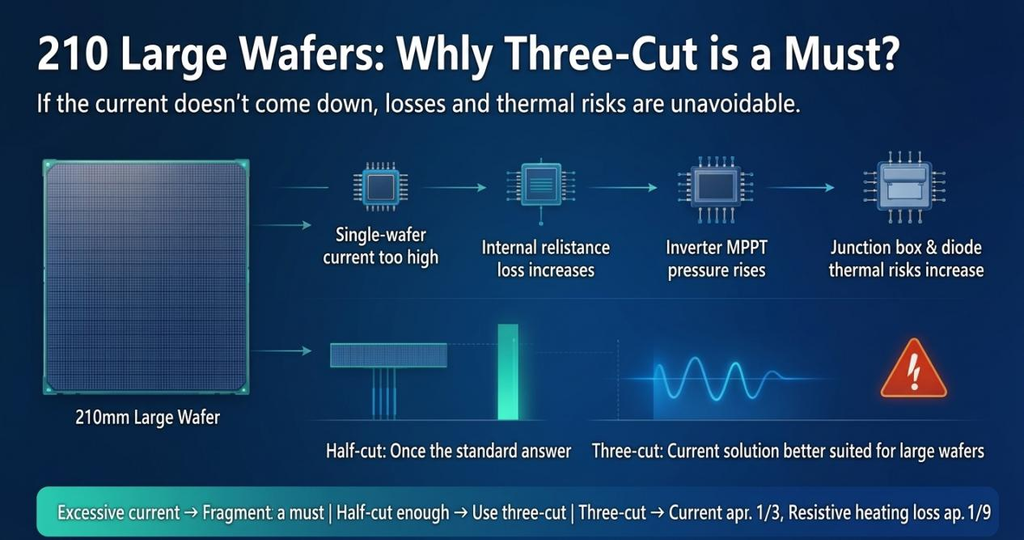
You may have noticed that solar modules keep getting more powerful. But increasing wattage is not just about making cells bigger or putting more cells into a module. How electricity moves through the module matters, too.
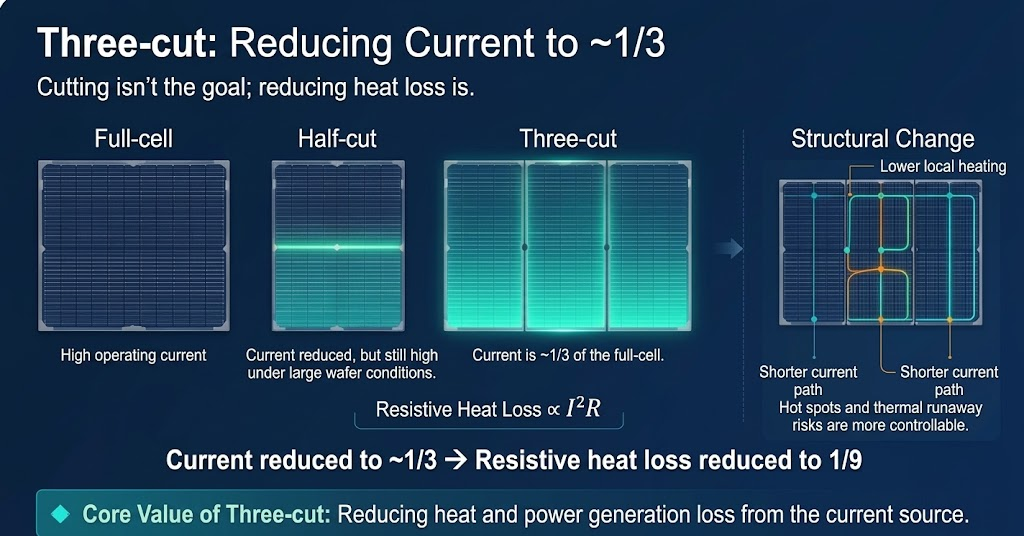
This is where the three-cut cell design used in JA Solar DeepBlue 5.0 caught my attention.
Compared with conventional half-cut cell designs, three-cut technology changes how the cells are divided and how the module’s internal electrical connections are arranged. The goal is to improve electrical performance while making better use of the module’s design.
Of course, cutting a cell into more pieces does not automatically make a module better. Manufacturing quality, cell efficiency, and the way everything is connected still matter.
For me, the interesting part is how these elements work together. A technology is only valuable when it brings a real benefit to the finished product.
2. What Happens When a Solar Module Is Partly Shaded?
Think about a real solar installation. Nearby buildings, trees, mounting structures, or even neighboring rows of modules can cast shadows across the panels.
Shading may seem like a small problem, but it can affect how a solar system operates.
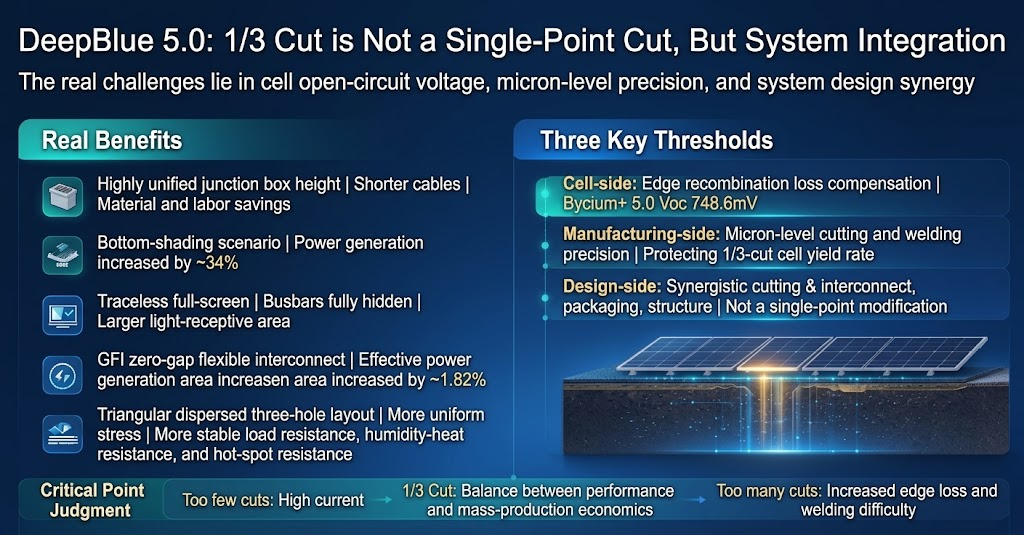
According to JA Solar’s technical materials, JA Solar DeepBlue 5.0 can deliver approximately 34% higher power generation under a specified bottom-shading test condition, compared with conventional half-cut modules under the same conditions.
That number is worth paying attention to, but it needs context. It does not mean every project will generate 34% more electricity. Actual results depend on the shading pattern, system design, inverter configuration, and site conditions.
Still, if your project has unavoidable shading, it makes sense to look beyond rated power and ask how different module designs handle it.
A little more usable area
Another detail I find interesting is the module’s seamless full-screen design, which hides the busbars, combined with GFI zero-gap flexible interconnection technology.
According to JA Solar’s product information, this design increases the effective light-receiving area by approximately 1.82%.
It may not be the first thing you notice when looking at a solar panel, but small design choices can make a difference. The important question is whether they contribute to better overall module performance.
JA Solar DeepBlue 5.0 module structure and interconnection design3. The Part Buyers Don’t Always See: Manufacturing
There is something else I think buyers should keep in mind.
A new cell design may look promising on paper, but turning it into a reliable product at mass-production scale is another challenge.
Cutting cells into more pieces requires careful control of manufacturing quality, electrical connections, and potential losses around the cut edges. If these details are not handled properly, the design may not deliver its intended benefits.
JA Solar DeepBlue 5.0 combines its three-cut cell design with Bycium+ 5.0 cell technology. JA Solar’s technical materials report an open-circuit voltage of 748.6 mV for the cell.
But honestly, I wouldn’t choose a module based on one technical number alone.
I would also want to understand its overall performance, product quality, warranty coverage, and supply reliability. For a project with a tight construction schedule, delivery matters, too.
A good product is important. Getting the right product to the customer when it is needed is part of the job as well.
4. Why I’m Paying Attention to DeepBlue 5.0 for the Middle East
For our customers in the Middle East, I think there are two practical issues that deserve more attention: heat and dust.
Let’s start with temperature.
Solar modules work outdoors, often under strong sunlight for long periods. As their operating temperature rises, their power output generally decreases. That is why the temperature coefficient matters when comparing modules for hot climates.
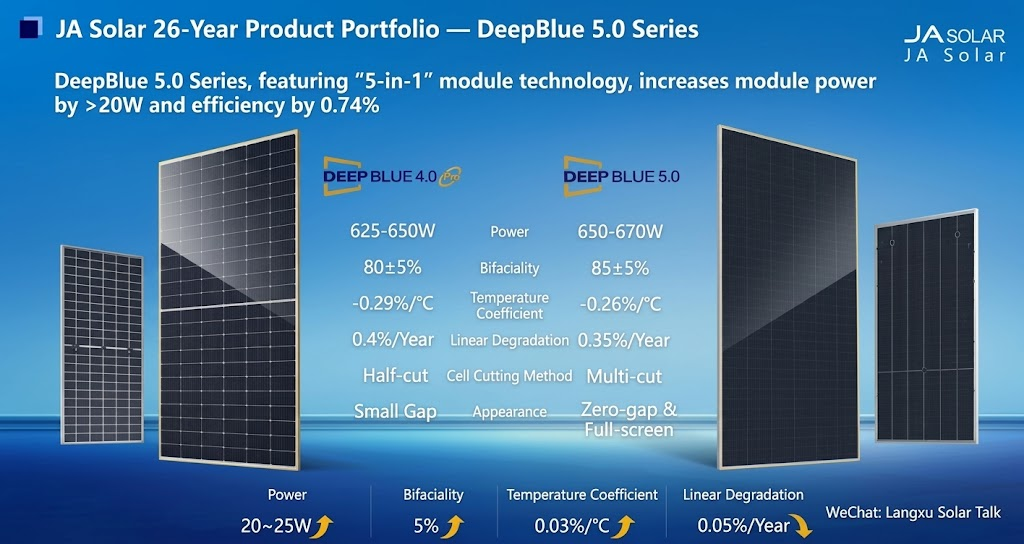
According to JA Solar’s product information, JA Solar DeepBlue 5.0 has improved its temperature coefficient from -0.29%/°C to -0.26%/°C. At a module operating temperature of 55°C, JA Solar reports an approximately 0.9% improvement in power-generation performance.
The difference may not sound dramatic at first. But when evaluating a project expected to operate for many years, I think it is worth understanding how a module behaves under the conditions it will actually face.
Dust is another issue that is easy to underestimate.
In dusty environments, dirt accumulating on the module surface can reduce the amount of sunlight reaching the cells. Cleaning also takes time, water, labor, and money. Depending on the project location, these costs can become an important part of ongoing operations.
DeepBlue 5.0’s anti-soiling design is therefore another feature worth looking at. It is not a replacement for proper maintenance, but it may be relevant when evaluating how to manage soiling-related losses and cleaning requirements.
Of course, every site is different. A project in a particularly dusty area may have different needs from one near the coast or in a less challenging environment.
That’s why I would always encourage customers to consider local conditions alongside the datasheet, rather than choosing a module based on wattage or price alone.
5. So, Is JA Solar DeepBlue 5.0 Worth Considering?
My answer is: it depends on the project, but there are good reasons to take a closer look.
What interests me about JA Solar DeepBlue 5.0 is not just its high power rating. It is the combination of three-cut cell technology, shading performance, effective use of module area, structural design, and features intended for demanding operating conditions.
Not every project needs the same things. Some buyers may prioritize upfront cost. Others may care more about shading, high temperatures, maintenance, or long-term reliability.
There is no single module that is automatically the best choice for every situation.
As a JA Solar authorized distributor, I see our role as more than simply providing a price. We need to understand what the customer is building, what challenges the project may face, and which product makes the most sense for those requirements.
Because when a customer invests in solar, they are not just buying panels. They are investing in a project that needs to perform over time.
And to me, that is the more useful way to look at solar technology: not just what a module can achieve on paper, but what it can bring to a real project.
Considering JA Solar DeepBlue 5.0 for your next project? Get in touch with us to discuss product specifications, availability, and whether it suits your project requirements.
JA Solar DeepBlue 5.0:
More Than Just Higher Wattage