When we talk about solar panels, most buyers naturally focus on wattage, efficiency and price. That’s understandable. These are usually the first things we compare when choosing modules for a project.
But after working in the solar industry for years, I’ve come to realize that some of the most important details are not always visible on a product datasheet.
Take the tiny metal grid lines on a solar cell, for example.
They play an important role in collecting and transferring electricity. And while they may look like a very small part of a solar panel, their material properties and manufacturing quality can have a lasting impact on electrical performance.
One question worth looking at is how silver and copper behave during manufacturing, especially when oxidation becomes a concern.
It may sound like a small technical detail, but for a solar module expected to operate for decades, small details deserve attention.
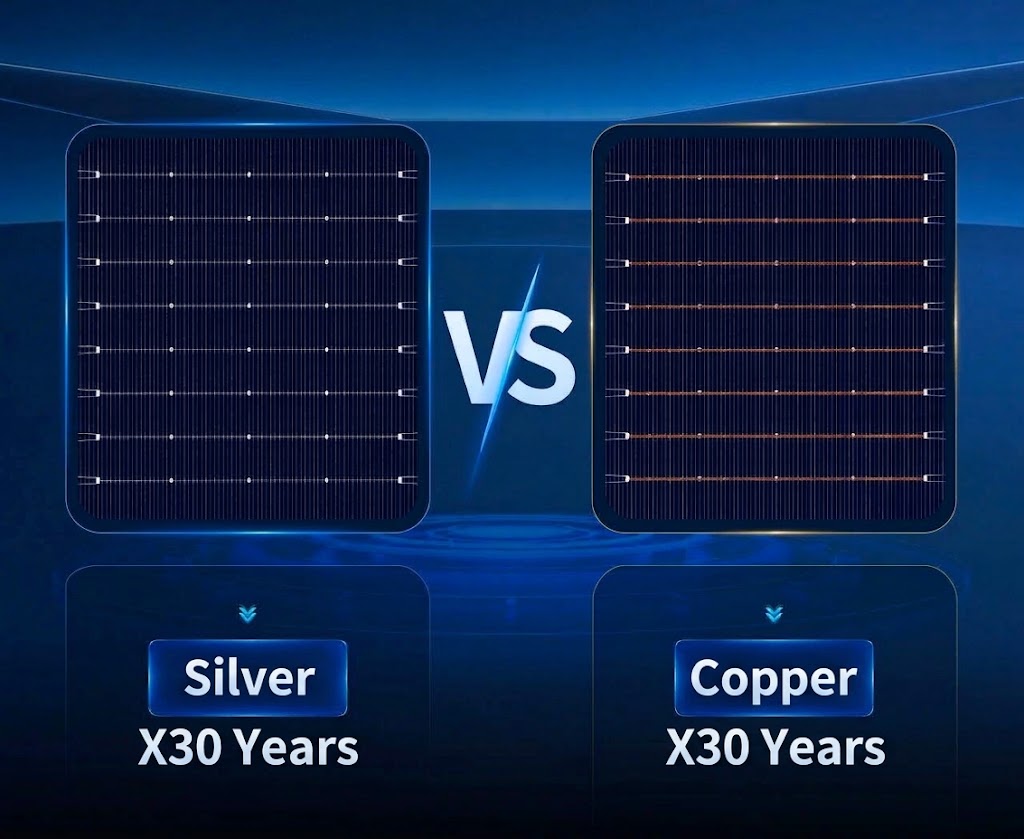
1. Silver and Copper: Both Conduct Electricity, But They Behave Differently
Silver and copper are both excellent electrical conductors. However, their behavior during solar cell manufacturing is not exactly the same.
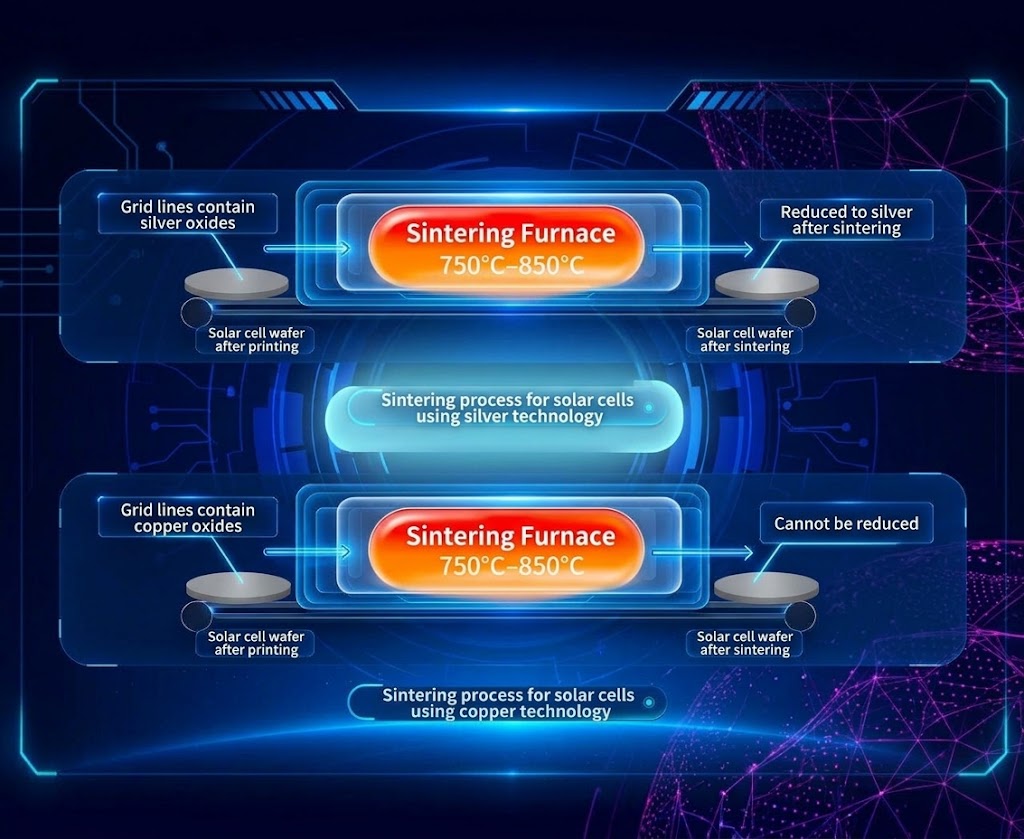
In conventional silver-based metallization, silver paste is printed onto the solar cell and then goes through a high-temperature firing process. Depending on the cell technology and manufacturing conditions, firing temperatures are typically around 750°C–850°C.
This process helps form the electrical contact between the metal grid lines and the silicon surface.
One interesting characteristic of silver is its relatively favorable behavior during this process. Silver oxide is thermally unstable and can decompose at elevated temperatures. This helps make silver-based metallization suitable for conventional high-temperature firing processes.
Copper is different.
Copper can oxidize relatively easily, particularly at elevated temperatures. The resulting copper oxides are less conductive than metallic copper. If oxidation occurs at critical electrical contact areas, it can increase contact resistance and affect electrical performance.
Does this mean copper cannot be used in solar cells? Not at all.
Manufacturers are developing different approaches to copper metallization, including protective coatings and barrier layers, to control oxidation and copper diffusion.
However, these solutions require careful process design and manufacturing control.
The important point is that choosing a metal for solar cell metallization is not simply about its electrical conductivity. Its behavior during manufacturing and its compatibility with the entire cell structure matter just as much.
2. Why Does Electrical Contact Quality Matter?
Let’s bring this back to something more practical.
The metal grid lines on a solar cell have one main job: collect the electricity generated by the cell and transfer it efficiently.
If the electrical contact is not properly formed, additional resistance can occur, leading to electrical losses.
This is why contact quality matters.
A well-controlled metallization process helps establish a stable electrical connection between the metal contacts and the silicon surface.
There are three aspects worth paying attention to:
Lower contact resistance
Good electrical contact helps reduce unnecessary resistance at the interface between the metal and silicon. This supports efficient current collection and helps limit electrical losses.
Consistent manufacturing quality
For a residential installation, a small difference between individual modules might not immediately attract attention. But consider a utility-scale project involving tens of thousands of modules.
Manufacturing consistency becomes much more important when the same process is repeated across such a large number of cells and modules.
A better starting point for long-term performance
A solar module’s initial electrical performance is important, but it is not the whole story. Good contact quality provides a solid starting point for long-term operation.
Of course, metallization is only one part of module reliability. Encapsulation materials, cell interconnections, glass, backsheets and module design also play important roles.
3. Why Should Solar Project Buyers Pay Attention?
As a distributor, I understand that customers have many things to consider when purchasing solar modules.
Price, delivery time, power output and supplier reliability are usually high on the list.
But I also think it’s worth looking beyond the numbers on a quotation.
For a large solar project, the buyer is not simply purchasing individual modules. They are purchasing the expected performance of thousands or even hundreds of thousands of modules over many years.
Small differences in manufacturing quality can matter when repeated across such a large quantity.
This is particularly relevant in markets with demanding outdoor conditions.
Take the Middle East as an example.
Solar modules installed in this region often face high operating temperatures, intense sunlight and frequent dust accumulation. Coastal projects may also experience high humidity and salt exposure.
These conditions make material stability and manufacturing quality important considerations.
A good metallization process alone cannot guarantee that a module will perform perfectly for 25 or 30 years. But it is one of the details that manufacturers need to get right from the beginning.
For buyers, understanding these details can help make a more informed comparison between different solar module options.
4. The Real Test Begins After Installation
There is something I often think about when looking at solar module technology.
A module may leave the factory with excellent test results. But its real working life begins after installation.
It will face summer heat, winter cold, humidity, temperature changes and years of continuous outdoor exposure.
The tiny grid lines that collect electricity today will need to keep doing their job throughout that time.
Can the electrical contacts maintain their stability? How well can the materials withstand environmental stress? And how does the overall cell and module design protect electrical performance over the years?
These questions cannot be answered by looking at wattage alone.
They require proper material selection, manufacturing control, reliability testing and real-world performance data.
For me, this is one of the things that makes the solar industry interesting. The more you learn about the technology behind a solar module, the more you realize how many small decisions go into making a reliable product.
We often compare solar panels by their power ratings, efficiency and prices. But sometimes, the details we cannot easily see deserve just as much attention.
Because a solar panel is not built to perform for just one year. It’s built for the long run.