Best Solar Panels for High-Temperature Climates: Desert & Tropical Guide
Solar panels love sunlight, but honestly, they don’t love heat. For folks in desert or tropical areas, this is a real headache when you want to install solar.
Once panel temperatures climb above 77°F, power output starts slipping. In places like Phoenix or Dubai, panels can hit 165°F, and that’s when standard solar tech loses 15-20% of its potential electricity production.
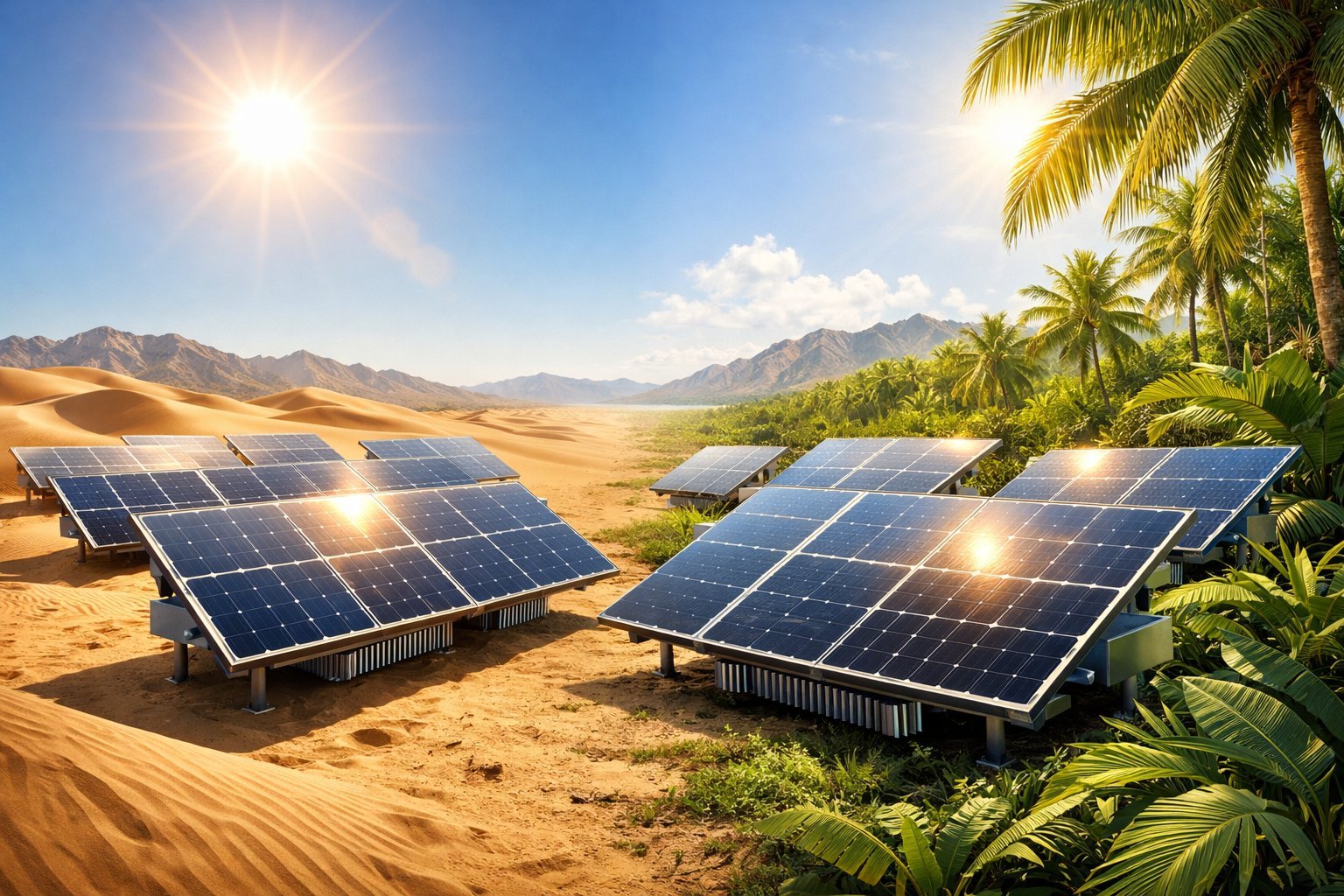
Advanced solar panel technologies like HJT, TOPCon, HPBC, and ABC lose 25-50% less power in extreme heat compared to standard panels, making them worth the investment in hot climates. These newer designs use N-Type silicon cells and clever engineering to handle high temperatures much better.
Choosing the right tech versus the wrong one can mean hundreds of extra watts on your roof—and thousands saved over the system’s life. Your location really determines which panel type is best.
Desert regions demand maximum temperature tolerance. Tropical areas need panels that don’t wilt in heat or humidity.
This guide lays out which technologies actually perform in high-temperature conditions and how to pick panels that won’t let you down where you live.
Key Takeaways
- Solar panels lose 0.4-0.5% of their power for every degree above 77°F, so picking the right tech matters in hot climates.
- N-Type technologies like HJT, TOPCon, HPBC, and ABC offer temperature coefficients of -0.20% to -0.30%/°C, while standard PERC is stuck at -0.40%/°C.
- Proper installation—elevated mounting and good airflow—can drop panel temps by 20-40°F and give you a real performance boost.
How Heat Impacts Solar Panel Performance
Heat drags down solar panel efficiency in measurable ways—mainly through the temperature coefficient and cell operating temperature.
If you get how these work, you’ll have a much better shot at picking panels that hold up in desert and tropical environments.
Temperature Coefficient and Its Importance
The temperature coefficient tells you how much power your panel loses for every degree Celsius above 25°C. You’ll usually see it as a negative percentage, from -0.2% to -0.5% per degree Celsius.
Say your panel has a -0.3% temperature coefficient. For every degree above the baseline, it loses 0.3% of its power. On a scorcher when your panel hits 65°C, that’s 40 degrees above the baseline—so you lose 12% of your rated power to heat alone.
Lower temperature coefficients mean better performance in hot climates. Premium panels manage coefficients around -0.26% to -0.29%. Standard ones? Often -0.4% or worse.
Typical Efficiency Loss in Hot Climates
Solar panels can lose 10-25% of their efficiency in really hot conditions. Your panels usually run 20-30°C hotter than the air around them.
In the desert, when air temps hit 45°C, your panel surface can bake at 75°C or more. A panel with a -0.4% coefficient loses 20% of its rated power at that temp—and this happens during peak sun hours, when you need the juice most.
Different climates, different headaches:
- Desert regions: Brutal sunlight and panel surfaces over 50°C
- Tropical areas: High humidity and steady heat mean 15-20% efficiency loss at midday
- Coastal hot zones: Salt air plus heat equals faster performance drop
Nominal Operating Cell Temperature (NOCT)
NOCT tells you what temp your solar cells hit under certain conditions: 800 W/m² sunlight, 20°C air, and a gentle breeze. Most panels show NOCT between 42-46°C.
Lower NOCT values mean better heat management. Panels built for hot places get NOCT scores of 41-43°C thanks to smarter ventilation and cell design.
This 3-4 degree edge means 1-1.5% better efficiency out in the wild. Installation matters too. Rooftop mounting with good airflow keeps panels cooler than ground arrays that trap heat.
Leave at least 6 inches between your roof and the panels if you want real cooling.
Heat-Related Degradation Over Time
Solar panels wear out faster in hot climates. Standard degradation rates of 0.5-0.8% per year can jump to 1-1.5% annually in extreme heat.
High temps stress the panel materials, especially the encapsulation and cell connections. All that heating and cooling causes microcracks, which slowly kill your output.
Panels built for high temperatures use:
- N-type cells instead of P-type, so they degrade slower
- Advanced encapsulation materials that shrug off thermal stress
- 16BB or multi-busbar tech to cut down on microcracks
Good panels designed for heat keep about 90% of their original output after 10 years and 80% after 25. Standard ones might drop to 85% after 10 years and 75% after 25 years in the same conditions.
Top Solar Panel Types and Technologies for Extreme Heat
Different solar panel technologies tackle extreme heat in their own ways. N-Type cells and heterojunction panels really shine here, while traditional monocrystalline and PERC options still give solid performance for less money.
Monocrystalline Panels Advantages
Monocrystalline solar panels use single-crystal silicon cells. They’re more efficient than other types, usually clocking in at 20-23% efficiency, and they handle heat better than polycrystalline choices.
The single-crystal structure lets electrons move more freely, so resistance and heat buildup drop. Most monocrystalline panels have temperature coefficients between -0.30%/°C and -0.40%/°C.
Monocrystalline PERC panels add a special rear cell layer that bounces unused light back into the cell. This gives you a 1-2% efficiency bump and shaves a bit off the temperature sensitivity compared to plain monocrystalline panels.
Monocrystalline panels work great in desert regions where you don’t have much space and need the most power per square foot.
N-Type and Heterojunction (HJT) Technology
N-type solar cells bring a big leap for hot climates. They use phosphorus-doped silicon instead of the usual boron-doped P-type silicon.
Key benefits of N-type technology:
- Temperature coefficients as low as -0.24%/°C to -0.29%/°C
- Annual degradation rates around 0.35%, while PERC sits at 0.5-0.7%
- 88-90% output left after 30 years
- They just do better in low-light and high-heat situations
Heterojunction technology mixes thin amorphous silicon layers with crystalline silicon cells. This hybrid structure keeps efficiency up even when panels pass 65°C (149°F).
HJT panels have the best temperature coefficients you’ll find, sometimes as low as -0.24%/°C.
Thin-Film and Bifacial Solar Panels
Thin-film solar panels use stuff like cadmium telluride, not crystalline silicon. They’re less efficient (15-18%), but they shrug off heat better than the usual suspects.
Cadmium telluride panels even get a little performance boost in the heat, so they’re a smart pick for big commercial jobs in extreme climates. The catch? You need more roof space to match the output of crystalline panels.
Bifacial panels soak up sunlight from both sides, which helps balance out heat losses. They’re especially handy in the desert, where sand or light-colored ground bounces sunlight back up.
With reflective ground cover, bifacial panels can boost your total energy by 15-25%.
Comparing Polycrystalline and PERC Panels
Polycrystalline panels use a mix of silicon crystals melted together. They’re less efficient than monocrystalline, and in 45°C heat, they can lose 15-18% efficiency.
Temperature performance comparison:
| Technology | Typical Temp Coefficient | Efficiency Loss at 45°C |
|---|---|---|
| Polycrystalline | -0.40% to -0.50%/°C | 15-18% |
| Monocrystalline PERC | -0.30% to -0.40%/°C | 12-15% |
| N-Type/HJT | -0.24% to -0.29%/°C | 8-10% |
PERC panels handle heat better than standard polycrystalline and cost less than top-shelf N-type options. A lot of modern PERC panels use 16BB cell technology (16 busbars) to drop electrical resistance and help with heat dissipation.
PERC is a practical middle ground for desert or tropical installs—if you care about budget but still want decent hot-weather performance, it’s a solid choice.
Best Solar Panels for Hot Desert and Tropical Regions
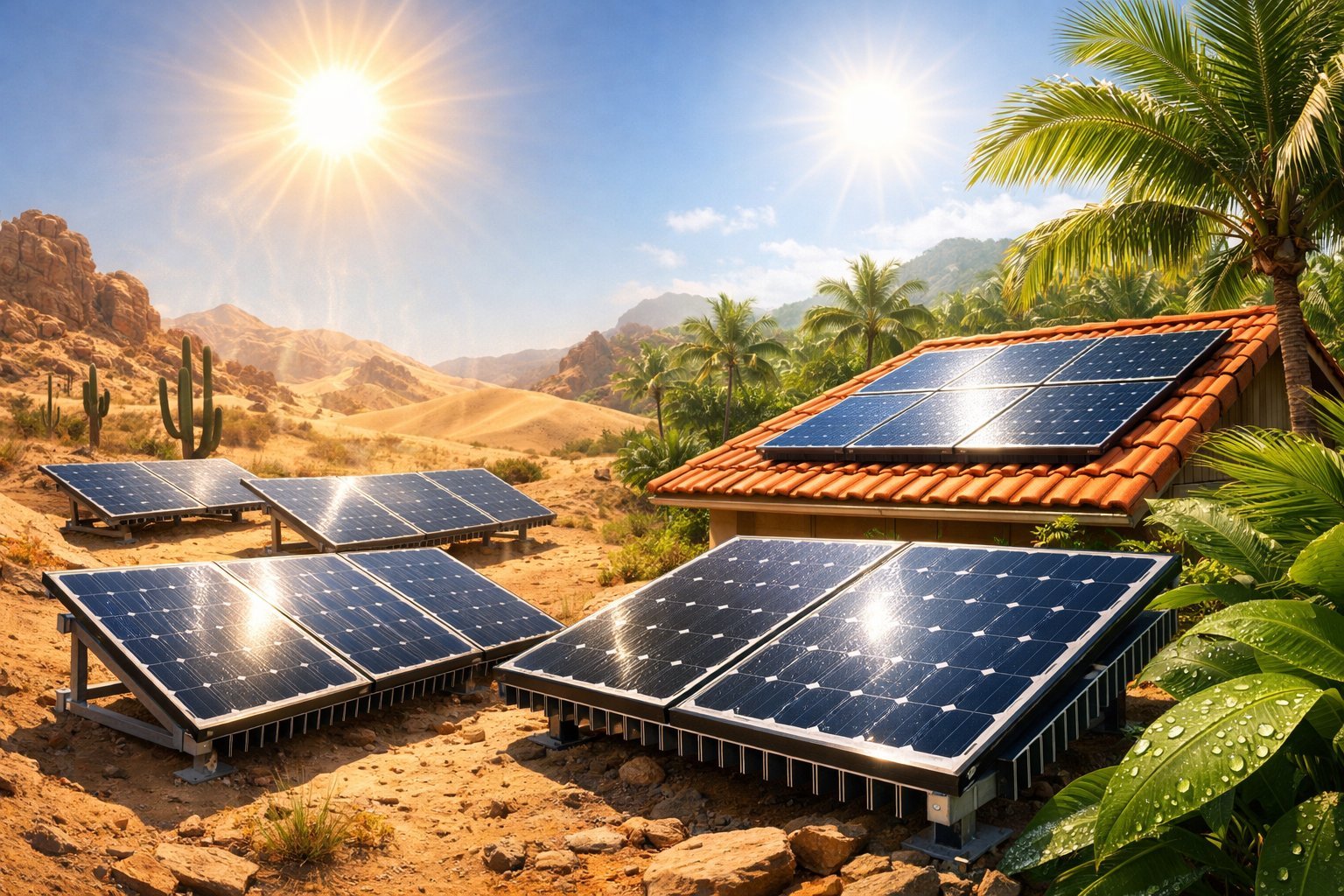
If you want panels that won’t quit in extreme heat, you need to look at temperature performance, build quality, and long-term durability. The best models balance high efficiency with real heat tolerance, and the warranties have to account for the thermal stress your panels will face in desert and tropical weather.
Top-Rated Models for High Temperatures
The Panasonic Evervolt stands out with a temperature coefficient of -0.24%/°C. It loses less power when temps rise above 77°F and keeps about 92.4% efficiency at 113°F, which is impressive compared to most panels in desert heat.
REC Alpha panels bring solid value, pairing a strong temperature coefficient with half-cut cell tech. At 113°F, they show only 10.4% efficiency loss, and you’ll usually find them around $2.49 per watt.
SunPower Maxeon 6 gives you a 40-year warranty and a -0.29%/°C temperature coefficient. In Phoenix field tests, these panels held 91.2% of their rated efficiency during brutal summer highs.
Canadian Solar TOPHiKu6 delivers up to 450W with a -0.29%/°C temperature coefficient. The larger panel size fits well for tight spaces needing maximum power density.
Jinko Tiger Neo backs up its reliability with a 30-year performance warranty. Nevada installations showed barely any degradation after 18 months of punishing heat.
Brand and Technology Comparisons
SunPower and Panasonic use copper foundations and advanced cell structures that run cooler in direct sun. Sure, they cost more, but you’ll see 2-3% better performance in deserts than with basic monocrystalline panels.
Canadian Solar and REC use half-cut cells to lower operating temps. They split cells into smaller chunks, which reduces resistance and cuts down on heat during use.
LONGi Hi-MO X6 and Silfab Elite offer decent heat performance for less money. LONGi’s at -0.28%/°C for $2.58 per watt, and Silfab, made in North America, has a -0.37%/°C rating.
Premium panels with N-Type silicon tech handle heat much better than standard PERC cells. They keep 88.85% output after 30 years, with only 0.35% annual degradation, while older designs lose 0.5-0.7% yearly.
If you’re in a tropical climate, you’ll want extra corrosion resistance for humidity and salt air. Marine-grade junction boxes and beefed-up frame coatings keep panels from breaking down near the coast.
Key Specifications: Efficiency, Temperature Coefficient, NMOT
Temperature coefficient tells you how much efficiency drops per degree above 77°F. For deserts, look for -0.30%/°C or better. A panel with -0.35%/°C loses 14% efficiency at 149°F, but one with -0.24%/°C only loses 9.6%.
NMOT (Nominal Module Operating Temperature) shows how hot panels get under standard conditions. Try to find panels rated at 42-45°C. If NMOT is over 47°C, panels run hotter and degrade faster in extreme heat.
Panels with 21-23% efficiency hit the sweet spot for hot climates. Sometimes, a 21% efficient panel with great heat tolerance will outperform a 22.5% panel that can’t handle the heat.
Check the operating temperature range for max limits. Good panels run up to 185°F, but efficiency drops off hard at those temps. Panels work best below 140°F, so proper mounting and ventilation matter a lot.
Warranty and Durability Considerations
Performance warranties should promise at least 85% output after 25 years in hot climates. SunPower goes up to 40 years, while most mid-tier options last 25-30 years.
Product warranties that cover thermal cycling matter because deserts see 60°F swings between day and night. That kind of stress wears out panel materials over years.
Stick with brands that know hot markets like Arizona, Texas, and Florida. They get the challenges and usually respond better to warranty claims.
Labor coverage for heat-caused failures can save you money. Some brands add extra installation coverage if you use certified installers, so you pay less for future repairs.
Corrosion warranties are a must in tropical areas. Marine-grade parts with 25-year coverage help panels survive salty, humid air without falling apart early.
Installation and Maintenance Strategies for Hot Climates
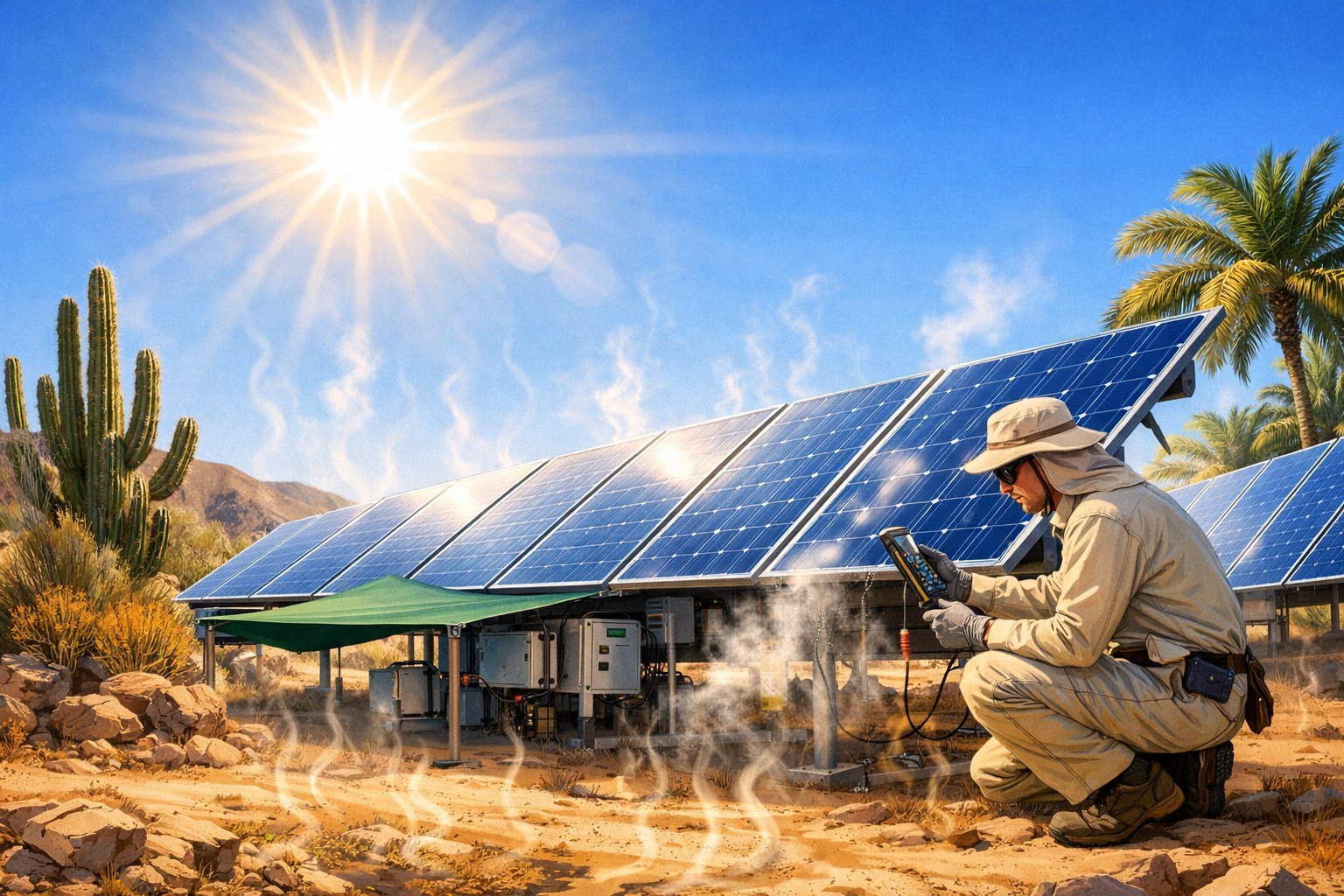
How you install and maintain your solar panels makes a huge difference in hot climates. Smart mounting drops panel temps by 10-15 degrees, and regular maintenance keeps heat from slashing your energy output by as much as 20% when things get extreme.
Optimal Placement and Mounting for Heat Mitigation
Install panels with plenty of airflow underneath—at least 6-8 inches above the roof helps cool them off. Ground-mounted systems actually do better in hot areas since air moves freely all around.
Pick mounting hardware made from aluminum or stainless steel. These materials don’t expand much and resist corrosion. Skip black rails in the desert—they just soak up more heat and pass it to your panels.
Your tilt angle isn’t just about sunlight; it also affects heat. In hot places, tilt panels 5-10 degrees higher than your latitude to boost airflow and cut down on dirt that traps heat.
Light-colored roofs reflect heat and keep panels cooler than dark ones. If you’re swapping out your roof before solar, go with something reflective or light—could bump your performance up by 3-5%.
Maximizing ROI and Payback in Extreme Heat
Expect a payback period of 6-9 years in hot climates if you pick panels with top-notch temperature coefficients. Premium panels cost more up front—maybe 15-25%—but give you 8-12% better performance in the heat, which can shave 6-12 months off payback.
Use real-world hot climate data when you calculate ROI, not just lab numbers. If your system produces 20% less than the rated power because of heat, your payback will take longer—no way around it.
Net metering in hot states like Arizona and Texas makes a big difference. Peak solar output usually lines up with high power rates, so you could see 15-20% better returns.
Adding battery storage helps, too. Store midday power for evening use, shift your consumption to peak periods, and you might cut payback by another year or two.
Maintenance Practices for Longevity and Efficiency
Clean your panels every 4-6 weeks in dusty places—dirt can drop output by 15-25%. Do the cleaning early or late in the day when panels are cool, or you risk cracking them from thermal shock.
Check for hot spots every quarter with a thermal camera or your monitoring app. If you find one, fix it fast—cell damage just gets worse in the heat.
Tighten all electrical connections every six months. Heat and cooling cycles loosen stuff faster in hot climates, and loose connections mean more resistance and extra heat.
Keep an eye on your inverter during heat waves. Inverters might need shade or even fans to keep from overheating. If it’s dusty, swap out inverter air filters every month.
Trim plants around ground-mounted systems every few months. You want air moving around your panels, and no extra shade that could cause hot spots.
Frequently Asked Questions
Advanced tech like HJT, TOPCon, and back-contact panels handle heat way better, with temperature coefficients between -0.20% and -0.30%/°C. Premium N-Type panels usually come with 30-year warranties guaranteeing 88-89% output retention. IEC 61215 certification means they’re tough enough for extreme conditions.
What are the most efficient solar panel types for operation in high-temperature environments?
Heterojunction Technology (HJT) panels reach 22-25% efficiency and keep cool with temperature coefficients of -0.20% to -0.30%/°C. They use crystalline silicon plus thin amorphous silicon layers, so they soak up more light and shrug off heat better than old-school panels.
TOPCon panels hit 22-23% efficiency and -0.30%/°C, and prices keep dropping as more factories ramp up. HPBC and ABC panels can get up to 24.8% efficiency and -0.26%/°C by moving all the metal contacts to the back, which boosts light absorption and cuts voltage loss from heat.
All these use N-Type silicon instead of P-Type. N-Type just handles heat, efficiency, and long-term wear better in hot places.
CdTe thin-film panels offer about 19% efficiency with killer temperature coefficients, sometimes as low as -0.17% to -0.25%/°C. They keep 70-80% of rated power even on hazy days and have shown 88% output retention after 27 years in harsh heat.
How does heat impact solar panel performance, and which models withstand this the best?
Solar panels make power from sunlight, not heat. When they get hot, voltage drops and you lose power—even if current rises a bit.
Standard PERC panels lose around 0.4% of power for every degree Celsius over 77°F (25°C). In desert installs, where panels might hit 158°F (70°C), you’re looking at 18-20% losses.
Panels run way hotter than the air—usually 36-72°F (20-40°C) above ambient. Your roof can hit 140°F (60°C) on a summer afternoon, and desert setups often see 165°F (75°C) or more.
CdTe panels are champs at handling heat, with temperature coefficients as low as -0.17%/°C. At 158°F, they lose just 9% of their power. HJT panels lose about 11.25%, while top-tier ABC and HPBC panels lose only 9.1%. Standard PERC panels? They lose 18%—so they’re 50-100% worse than the best heat-tolerant options.
What are the cooling techniques or technology advancements in solar panels suitable for desert regions?
Back-contact panels (ABC and HPBC) put all the metal on the back, so the front gets more sunlight and less resistance, which helps keep voltage up when it’s hot.
N-Type silicon tech is a game changer for hot climates. It’s just more resilient to heat stress and degrades slower than old P-Type cells.
Raising panels above the roof is a simple and cheap way to cool them. Even a few inches of airflow can drop panel temps by 18-36°F (10-20°C) compared to panels mounted flat against the roof.
Ground-mounted systems run 20-30°F cooler than roof setups, thanks to all that air moving underneath. Light-colored roofs help a bit, too, by bouncing heat away.
Half-cell designs chop up standard cells, reducing resistance and heat. When you combine this with back-contact or N-Type tech, you get even more thermal benefits for extreme climates.
Can you explain the importance of temperature coefficient when selecting solar panels for tropical climates?
The temperature coefficient tells you how much power a panel loses for every degree above 77°F (25°C). For example, a coefficient of -0.40%/°C means the panel drops 0.4% in output with each degree Celsius over that point.
In tropical climates, panels can hit 140°F (60°C) pretty regularly. At that temperature, a standard PERC panel with -0.40%/°C loses about 14% of its power.
Meanwhile, a premium HJT panel with -0.25%/°C only loses around 8.75% under the same heat. That gap gets noticeable fast.
If you run a 20-panel system rated at 400W each, the difference adds up to 420 watts of lost power during peak hours. That’s not pocket change—over 25 years, those losses can mean thousands of dollars gone.
Manufacturers measure temperature coefficients in labs, following IEC 61215 standards. Sure, wind, humidity, dirt, and how you mount the panels all play a role, but the coefficient gives you the clearest sign of how well a panel handles heat.
If you’re dealing with tropical heat and humidity, go for panels with coefficients of -0.30%/°C or better. CdTe and HJT technologies really shine here, keeping 70-80% efficiency even on hazy, hot days. They just handle the heat better—no question.
What warranties and guarantees should one look for when purchasing solar panels for high-temperature areas?
Premium N-Type panels—like HJT, TOPCon, ABC, and HPBC—usually come with a 30-year performance warranty. They promise at least 88-89% output retention.
These warranties limit annual degradation to just 0.35% from year 2 through 30. That’s a lot better than what you’ll get with standard PERC panels, which degrade at about 0.5-0.7% per year.
Check that your product warranty covers manufacturing defects for at least 15-25 years. This kind of coverage protects you from physical failures, material flaws, and issues with workmanship—no matter the climate.
Try to find warranties that mention high-temperature performance. Some companies actually void their warranties if the panels run above certain temperatures, so those aren’t a good fit for desert or tropical areas.
The warranty should lay out the guaranteed output at year 25 and year 30. With premium panels, you’ll see guarantees of 88.85% or more after 30 years. Standard panels? They usually only guarantee around 80-84% after 25 years.
Don’t forget about the manufacturer’s financial stability and local service. A 30-year warranty won’t help if the company vanishes in 10 years or doesn’t have anyone nearby to help you out.