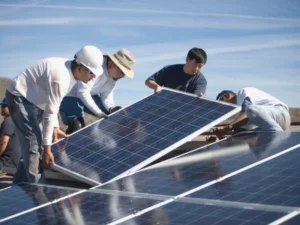
Solar panel efficiency basically tells you how much sunlight actually turns into usable electricity for your home. In 2026, the gap between top performers and average panels has grown wider than ever.
The most efficient solar panels in 2026 hit ratings between 22% and 24%. SunPower Maxeon 7 leads at 24.1% efficiency, with REC Alpha Pure-R at 22.3% and Panasonic EverVolt at 21.6%.
Higher efficiency means you can use fewer panels to get the same power output. If your roof space is limited or you just want to squeeze out every watt, it really matters.
The best solar panels for 2026 have been tested outside the lab, in all sorts of climates, to check if they actually live up to the hype.
Choosing between brands isn’t just about efficiency numbers. Consider warranty, how panels handle heat, and what you pay per watt.
This guide ranks the top solar panel brands by efficiency and digs into what those numbers really mean for your home’s energy and your wallet over time.
Key Takeaways
- Solar panel efficiency in 2026 ranges from 19.5% to 24.1%. Premium brands like SunPower and REC sit at the top.
- Real-world performance depends on temperature, degradation, and your climate—not just the efficiency percentage on the box.
- The best value usually comes from balancing upfront cost with long-term output, warranty, and how tough the panels are.
How Solar Panel Efficiency Is Measured
Solar panel efficiency tells you how much sunlight a panel turns into electricity you can use. Labs measure this using specific conditions, conversion rates, and other metrics to predict how panels will act on your roof.
Understanding Conversion Efficiency
Conversion efficiency is the percentage of sunlight that becomes electricity. So, if your panel is 20% efficient, it turns one-fifth of the sun’s energy into usable power.
Most efficient panels in 2026 range from 19.5% to 24.1%. Each extra 1% in efficiency gives you about 30-40 more watts per panel.
Those efficiency ratings come from lab tests, not your actual roof. Weather, roof pitch, and shading all affect what you really get.
Panels with higher conversion efficiency crank out more electricity from the same amount of space. If you’re working with a small roof, that’s huge.
SunPower’s premium panels reach 24% efficiency. Budget panels usually stick between 15-18%. The difference might not matter if you have plenty of space, but it’s a big deal for tight roofs.
Test Conditions and Methodologies
Labs use Standard Test Conditions (STC) to measure panels. That means 1,000 watts per square meter, 25°C cell temperature, and 1.5 air mass.
But let’s be honest—your roof almost never matches those lab settings. Sunlight and temperature swing all day long.
Some companies also share NOCT (Nominal Operating Cell Temperature) ratings. These use 800 watts per square meter, 20°C ambient temp, and a bit of wind. NOCT ratings give you a more “real world” sense of what to expect.
Field testing shows how panels really behave. Testing in Phoenix heat showed some panels held on to 96% of their rated output, while others dropped to 88-91%.
Key Metrics: Wattage, Temperature Coefficient, and Degradation Rate
Wattage is the maximum power output you’ll see under perfect conditions. Most residential panels now run from 300W to 440W each.
Temperature coefficient tells you how much power you lose as panels heat up. If the coefficient is -0.26%/°C, you lose 0.26% efficiency for every degree above 25°C. That adds up fast on a hot roof.
Degradation rate is how much efficiency your panels lose each year. The best panels lose just 0.25-0.5% annually. Cheaper ones can lose 1-2% per year.
After 25 years, a panel with 0.25% degradation still puts out 94% of its original power. A 1% degradation panel drops to 78%.
These three numbers—wattage, temperature coefficient, and degradation—really decide how much electricity you’ll get over the life of your system. High wattage, low temp coefficient, and slow degradation? That’s the sweet spot.
2026’s Most Efficient Solar Panels: Brand Rankings
The efficiency race in 2026 is wild. Top-tier panels are hitting 24.1% efficiency. SunPower Maxeon leads, with REC Alpha Pure-R and Panasonic right behind. Mid-tier brands are catching up and cost less.
Efficiency Percentages and Top Brand Standouts
SunPower Maxeon 7 takes the crown at 24.1% efficiency, setting the bar for the most efficient panels in 2026. It uses back-contact cell tech to grab every bit of sunlight.
REC Alpha Pure-R clocks in at 22.3% efficiency, giving you near-premium performance at a lower price. Panasonic EverVolt gets to 21.6% with HJT cell technology.
Mid-tier brands aren’t far behind. Q.Cells Q.TRON BLK M-G2+ hits 21.4%. LONGi Solar Hi-MO X10 gets to 21.2%. Canadian Solar HiKu7 TOPCon panels reach 21.0%.
Budget picks still hold their own. JinKo Solar Tiger Neo is at 20.8%. Trina Solar Vertex S, 20.7%. JA Solar JAM54S30 comes in at 20.5%.
The gap between premium and budget panels is down to about 3-4 percentage points now. Honestly, that makes mid-tier panels pretty tempting.
Real-World Performance Data
Lab efficiency ratings don’t always match what you get on your roof. Testing across five climates found big differences between claimed and actual output.
SunPower Maxeon 7 kept 96% of its rated output in 115°F Phoenix heat. Some competitors dropped to 88-91%. Its temperature coefficient of -0.26%/°C helps it hold up when things get hot.
In cloudy Seattle, Maxeon 7 produced 12% more energy than average panels. REC Alpha Pure-R handled shade well, thanks to half-cut cell design, and kept producing even when partly shaded.
Panasonic EverVolt did great in low light, making usable power at just 50W/m². HJT tech also helped it maintain 94% output at 110°F.
Degradation rates set premium panels apart. SunPower lost just 0.25% in the first year. Industry average is 1-2%. After five years, premium panels kept 98-99% of their original output, while budget panels dropped to 94-96%.
Panel Size, Design, and Output Comparison
Most residential panels are 61-69 inches long and 39-42 inches wide. Wattage varies from 380W to 440W, depending on efficiency and size.
Power output per panel:
- SunPower Maxeon 7: 415-440W
- Panasonic EverVolt: 380-410W
- REC Alpha Pure-R: 405-430W
- Q.Cells Q.TRON: 400-425W
- LONGi Hi-MO X10: 390-420W
Higher efficiency panels squeeze out more watts from less roof space. A 24.1% Maxeon makes the same power as a 20% panel in 17% less area. That’s a game changer for small roofs.
Bifacial panels from Canadian Solar, Trina Solar, and JinKo Solar grab reflected light from your roof, bumping up output by 5-15%. They work best with light-colored roofs or ground mounts.
Panel weight ranges from 44-47 pounds. Lighter panels like REC Alpha Pure-R (44 lbs) put less strain on your roof.
Advanced Solar Cell Technologies in 2026
Several cell types are battling it out in 2026. N-type cells and back contact designs are pushing efficiency past 24%. Bifacial technology now grabs sunlight from both sides of the panel.
N-type, TOPCon, and Heterojunction (HJT) Cells
N-type cells have basically taken over in 2026, replacing older p-type designs in most premium panels. They resist light-induced degradation better and keep up their performance for 30 years or more.
TOPCon technology leads the n-type pack. JinkoSolar hits 23.69% efficiency and Trinasolar gets to 23.7% in commercial modules. TOPCon uses thin oxide layers to reduce electron loss, which bumps up voltage and current.
Heterojunction (HJT) cells have made a comeback in 2026. Risen Energy’s HJT modules now reach 23.8% efficiency at 740W, putting HJT back ahead of TOPCon for the first time since 2025. HJT blends crystalline silicon with thin amorphous silicon, giving both surfaces top-notch passivation.
HJT panels also handle heat better than monocrystalline PERC or regular TOPCon designs. Their temperature coefficient usually falls between -0.24% and -0.26% per degree Celsius, so you lose less power on those brutally hot days.
Half-Cut, Multi-Busbar, and Back Contact Innovations
Half-cut cells split standard solar cells into two pieces. This cut reduces resistive losses and improves shade tolerance across your array.
Most high-efficiency panels in 2026 use 132 or 144 half-cells instead of full-sized wafers. It’s a popular move for squeezing out extra performance.
Multi-busbar design has moved way past the old 5-busbar setup. Now, premium products use 9, 12, or even 16 busbars.
Advanced 16BB cell technology cuts down shadowing on the cell surface. It also helps collect current more evenly across the wafer.
This design works especially well with thin ribbon conductors that barely block incoming light. It just looks cleaner, too.
Back contact technology is where efficiency is really pushing boundaries in 2026. AIKO leads the pack at 24.8% with its BC module.
LONGi comes in second at 24.7% using hybrid interdigitated back contact (HIBC) tech. These panels move all electrical contacts to the rear surface, so you get zero front-side shading and a slick, uniform black look.
Back contact designs cost more than regular panels. But they deliver 15-20% more power per square foot of roof space.
Bifacial and Thin-Film Panels: Where Do They Stand?
Bifacial panels grab reflected light from the ground or roof through their transparent rear side. Depending on your setup, you could see 5-30% extra energy.
Most bifacial panels in 2026 use double-glass construction and bifaciality ratings between 70-90%.
Risen’s HJT bifacial module hits 90% bifaciality. That means the rear side generates 90% of the front side’s output if lighting is the same.
White roofs, light-colored gravel, or elevated ground-mount systems get you the most bifacial gains. It really depends on your site.
Thin-film solar panels are still a niche for homes, but they’re handy in commercial settings where weight matters more than efficiency. These panels run at 12-18% efficiency, compared to 23-25% for monocrystalline, so you’ll need about 50% more roof space for the same power.
Cadmium telluride (CdTe) thin-film dominates big utility projects. It costs less to make and does better in high heat.
Still, solar panel tech is shifting toward perovskite-silicon tandems. These could push thin-film efficiency above 30% by 2027 or 2028, if all goes well.
Durability, Warranty, and Degradation: Long-Term Panel Value
Premium panels cost more upfront, but you get better warranties and slower degradation. For example, a panel that loses just 0.25% efficiency each year will outproduce one degrading at 0.75% per year by a wide margin over 25 years.
Product and Performance Warranty Comparisons
Your product warranty covers manufacturing defects and physical failures. Your performance warranty guarantees a minimum power output over time.
SunPower Maxeon 7 stands out with a 40-year product and performance warranty, guaranteeing 92% output at year 25. Panasonic EverVolt offers 25-year coverage on both, with 90.76% output guaranteed at 25 years.
REC gives you 25-year product and performance warranties with 92% output at year 25. Most mid-range brands stick with 12-15 year product warranties and 25-year performance warranties, often guaranteeing 80-85% output.
Key warranty comparison:
| Brand | Product Warranty | Performance Warranty | Output at Year 25 |
|---|---|---|---|
| SunPower Maxeon 7 | 40 years | 40 years | 92% |
| Panasonic | 25 years | 25 years | 90.76% |
| REC | 25 years | 25 years | 92% |
| Silfab | 25 years | 30 years | 85% |
Degradation Rates and Output Guarantees
Premium panels lose just 0.25-0.5% efficiency each year. Standard panels lose about 0.75%, and that gap really adds up over time.
If you have an 8 kW system with premium panels degrading at 0.25% annually, you’ll generate about 11.5% more electricity over 25 years compared to panels degrading at 0.75%. That could mean $2,500-$5,000 in extra savings.
SunPower Maxeon 7 drops just 0.25% in year one, then 0.2% per year after. Most quality panels lose more in the first year—sometimes 1-2%—before settling to 0.5-0.75% annually.
Panel Lifespan and Manufacturer Reliability
Solar panels usually last 25-30 years, losing efficiency slowly rather than failing outright. But your manufacturer’s stability matters when it comes to warranty claims down the line.
SunPower, Panasonic, and REC have decades of history. Newer brands might offer great warranties, but there’s a bigger risk they won’t be around if you ever need them.
Installation quality and local climate affect how long your panels last. Harsh climates with big temperature swings or salty air speed up degradation. Careful installation keeps out moisture and protects against mechanical stress.
Cost Analysis: Price vs. Performance in 2026
Solar panel prices in 2026 run from $2.50 to $4.20 per watt. Premium panels cost 40-70% more than standard ones.
The real question is whether the extra production from premium panels makes up for the higher cost over 25 years.
Cost per Watt and ROI
Cost per watt is the main way to compare solar panel prices. Standard panels average $2.50-$3.00 per watt, while premium options like SunPower Maxeon 7 top out at $3.80-$4.20 per watt.
Your return on investment depends on three things: system cost, electricity production, and local power rates. In California, where rates hit $0.31/kWh, you might see a 4.8-year payback on premium panels. In Texas, with $0.15/kWh rates, that stretches to 9.3 years for mid-range panels.
Premium panels pay off when roof space is tight or you have some shade. Their higher efficiency means you need fewer panels. If your roof is big and sunny, standard panels usually make more sense.
Panel Value Across Price Ranges
Budget tier ($2.50-$2.80/watt): These panels offer 19.5-20.5% efficiency and 25-year warranties. They’re basic but get the job done for most homes.
Mid-range tier ($3.00-$3.40/watt): REC Alpha Pure-R gives you 22.3% efficiency at a fair price. Most homeowners find this tier strikes the best balance.
Premium tier ($3.80-$4.20/watt): You pay 40-50% more for 23-24% efficiency, longer warranties, and slower degradation. That 0.25% annual degradation (versus 0.5-1% for standard) really adds up over time.
For a 6 kW system, expect to pay $15,000-$18,000 for budget panels, $18,000-$20,400 for mid-range, and $22,800-$25,200 for premium—before incentives.
Impact of Installation, Incentives, and System Sizing
Installation adds $0.50-$1.00 per watt to your total. Complex roofs, electrical upgrades, or tricky permits can bump costs higher.
The federal tax credit knocks 30% off your net cost in 2026. So, a $24,000 system drops to $16,800 after credits. Some states chip in with extra incentives, too.
Net metering lets you sell extra power back to the grid. If your state has good net metering, your ROI could improve by 15-25%. Maintenance runs $150-$300 per year for cleaning and inspections—nothing wild.
System sizing matters a lot. If you oversize, you waste money on unused production. Go too small, and you still have utility bills. Solar prices in 2026 are holding steady, so sizing your system right is key for getting the most value.
Installation, Compatibility, and Choosing the Right Panel
Panel efficiency doesn’t mean much if your installation isn’t up to par. The inverter you pick, your installer’s skill, and how well the panels fit your roof all shape your real-world energy output.
Certified Installers and Quality Assurance
How your installer does the job matters as much as the panels themselves. A certified installer with North American Board of Certified Energy Practitioners (NABCEP) credentials has passed tough tests and knows the ropes.
NABCEP-certified installers follow standard practices that help you avoid roof leaks, electrical headaches, or underperforming systems. They know the local codes, permits, and utility rules. When choosing your solar installer, check their license, insurance, and workmanship warranty.
Premium brands often require certified installers for warranty coverage. SunPower and Panasonic both have networks of certified pros trained on their products. If you use a non-certified installer, you might void your warranty—even if your panels are top-notch.
Ask installers for references from recent jobs like yours. See if they finish on time and handle warranty issues without hassle.
Inverters, Microinverters, and Power Optimizers
Inverters turn the direct current (DC) electricity from your panels into alternating current (AC) that your home can actually use.
String inverters tie multiple panels together through one central unit. Microinverters attach to each individual panel instead.
Microinverters cost $0.30-$0.50 more per watt. They perform better when your roof has shade, different angles, or panels facing multiple directions.
Each panel runs on its own, so shade on one panel won’t drag down the others. String inverters with power optimizers land somewhere in the middle for both performance and price.
Pick your inverter based on your roof’s quirks. String inverters work best for sunny, south-facing roofs with no shade.
Microinverters fit roofs with tricky layouts, some shade from trees, or panels pointing east and west.
Inverter efficiency ranges from 95% up to 99%. A 97% efficient inverter means you lose 3% of what your panels produce during conversion.
If you pair high-efficiency panels with a low-efficiency inverter, you’ll waste some of that extra power.
Fit for Roof Layout, System Size, and Climate
Your roof’s shape and direction really matter when picking panels. South-facing roofs in the northern hemisphere catch the most sun, so standard efficiency panels usually work well there.
East or west-facing roofs make about 15-20% less energy. Those spots benefit more from high-efficiency panels.
If you don’t have much roof space, choose panels with higher efficiency ratings to get more power per square foot.
A 24% efficient panel can make about 40 more watts than a 20% panel of the same size. That adds up fast if your roof is small.
Climate plays a role too. Hot climates need panels with low temperature coefficients (-0.26%/°C or better) so they don’t lose steam in the heat.
Panels in snowy places should have smooth glass to let snow slide off. If you’re near the coast, look for corrosion-resistant frames and sealed junction boxes.
Figure out your system size using your annual electricity use, available roof space, and how much sunlight you get locally.
Most homes need 6-10 kW systems, which usually means 15-25 panels depending on their wattage.
Emerging and Notable Brands to Watch in 2026
Some manufacturers are making big moves with better efficiency and a growing market presence. Qcells, Silfab Solar, and Canadian Solar all scored top spots in America’s Most Trusted Solar Panels for 2026, which just goes to show—newer brands can absolutely compete with the old guard.
Rising Manufacturers and Innovations
JinkoSolar keeps pushing for higher efficiency with N-type TOPCon cell tech. Their Tiger Neo panels hit 22.5% efficiency and still keep prices close to traditional panels.
Aptos Solar uses bifacial panels that grab reflected light from both sides. Depending on your setup, you could see 10-30% more energy produced.
Solaria cares about how panels look on your roof. Their PowerXT panels use a shingled cell design, so you don’t see gaps between cells—pretty slick if you’re worried about curb appeal.
Hyundai Energy Solutions brings car-manufacturing precision to solar. Their modules have defect rates under 0.2%, beating the industry average.
Talesun gives you 20-21% efficiency at wallet-friendly prices. They’re a solid pick for big residential installs where you’ve got plenty of roof space.
Regional Leaders and Global Expansion
Silfab Solar builds panels in North America, so you get faster delivery and support local jobs. They back their panels with a 25-year product warranty that even covers labor.
Canadian Solar is one of the biggest solar panel makers worldwide and has a strong international presence. Their HiKu7 series offers 21.4% efficiency without a premium price tag.
SEG Solar now has distribution networks across North America and Europe. Their 20.8% efficient panels are easier to find through certified installers these days.
Recom manufactures in Europe and holds themselves to high quality standards. If you have a warranty issue, their regional support centers usually handle claims faster than most Asian manufacturers.
Frequently Asked Questions
Solar panel efficiency has hit new highs in 2026. Top brands now offer panels between 19.5% and 24.1% efficiency. Back-contact cells and heterojunction designs help panels crank out more power in hot and low-light conditions.
What advancements have been made in solar panel technology to increase efficiency in 2026?
Back-contact cell designs get rid of front-grid shading, so panels catch more sunlight that would’ve been blocked by metal contacts.
Heterojunction (HJT) cell tech stacks two kinds of silicon layers. These panels hold up better in the heat—some keep 94% output at 110°F, while standard panels drop to 89%.
Half-cut cell designs cut down on power loss from shade. If part of a panel is shaded, only those cells lose output instead of the whole thing.
Temperature coefficients have improved to -0.26%/°C in top-tier models. That means your panels lose less juice on hot days compared to older tech.
Which solar panel brands lead the market in efficiency and performance this year?
SunPower Maxeon 7 takes the cake at 24.1% efficiency. These use back-contact tech and come with a 40-year warranty for both product and performance.
Panasonic EverVolt offers 21.6% efficiency using heterojunction cells. You get 25 years of comprehensive coverage, labor included.
REC Alpha Pure-R delivers 22.3% efficiency at a lower price than SunPower. These Norwegian-designed panels use half-cut cells and have a sleek, all-black look.
How do the newest high-efficiency solar panels compare to previous years’ models?
Modern panels degrade way less than older ones. New models lose just 0.25% in year one, while older panels used to drop 1-2% a year.
Performance gaps in the real world have shrunk a lot. The best panels now keep 96% of their rated output in extreme heat, compared to 85-88% for panels from five years ago.
Shade tolerance is much better these days. Current half-cut cell designs can still give you 85% of full-sun output in partial shade, while older panels fell to 60-70%.
What are the efficiency ranges for the top-performing solar panels available in 2026?
Premium panels hit 22% to 24.1% efficiency in 2026. These top models cost $3.00 to $4.20 per watt installed.
Mid-range panels run from 19.5% to 21.5% efficiency. Expect to pay $2.50 to $3.00 per watt for those.
Each 1% bump in efficiency gives you about 30-40 extra watts per panel. That’s a big deal if your roof space is tight.
Are there significant differences in performance among the highest-rated solar panel brands?
Temperature performance isn’t the same across brands. SunPower and Panasonic both reach -0.26%/°C, but some rivals are stuck at -0.35%/°C or worse.
Warranty coverage really varies. SunPower promises 40 years at 92% output after 25 years, while lots of brands only offer 25 years at 80-85% output.
Failure rates differ too. Premium brands report 0.08% to 0.12% defect rates, while the industry average sits between 0.5% and 1%.
In real-world use, top panels sometimes beat their lab ratings. The best ones produce 101% to 103% of their projected output, but budget panels can fall short.
What factors should consumers consider when comparing solar panel efficiency among different brands?
Look at real-world performance, not just those fancy lab efficiency numbers. Sure, a panel might hit 24% in the lab, but once it’s up on your roof, it could drop to 23.4% because of heat or other stuff you can’t control.
Climate really changes the game. If you live somewhere hot, you’ll want panels with low temperature coefficients.
For folks in cloudy regions, panels with strong low-light performance make a bigger difference than you’d expect.
If your roof is small, efficiency suddenly matters a lot more. Sometimes it’s worth paying extra for high-efficiency panels just to squeeze out every bit of power per square foot.
Don’t skip over warranties. You really want panels from financially stable companies that’ll actually be around to honor a 25- or even 40-year warranty.
Cost per watt isn’t everything. If a panel costs $200 more but gives you 8% more electricity over 25 years, that extra money could come right back to you in energy savings.