Sungrow PowerTitan 3.0 Passes Large-Scale Fire Test: What Does It Mean for Energy Storage Projects?
Fire Safety Is More Than a Technical Specification
When evaluating a battery energy storage system (BESS), it’s easy to focus on capacity, efficiency, system cost, and project payback.
These numbers matter. But there is another question worth asking before making an investment:
What happens if something goes seriously wrong?
Battery safety is not just about preventing faults. It’s also about limiting their consequences if they occur. That’s why large-scale fire testing deserves more attention.
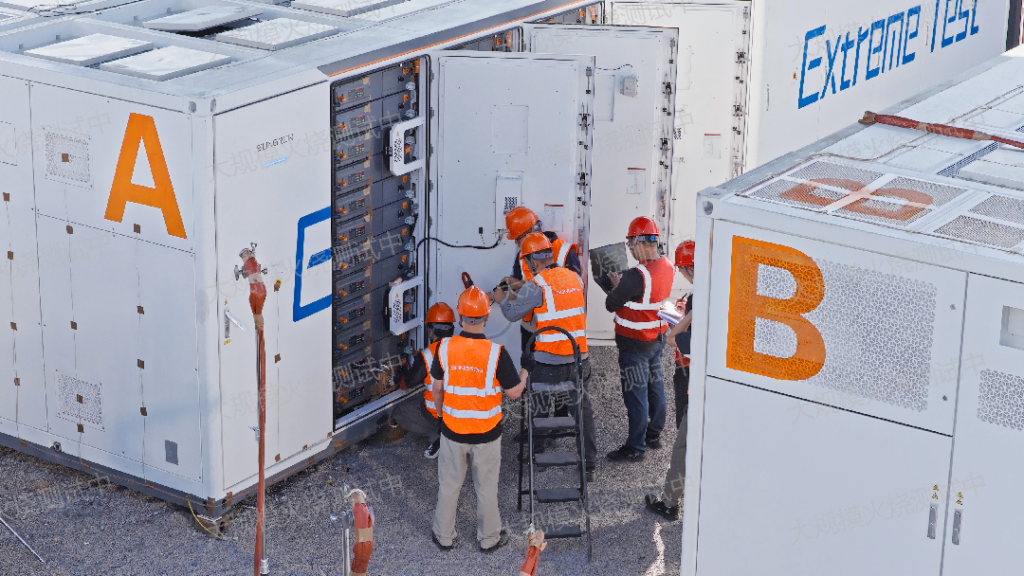
On October 21, 2026, Sungrow announced that its PowerTitan 3.0 AC-coupled energy storage system had passed a large-scale fire test. According to the company, the test was conducted by UL Solutions, witnessed by Fire Risk Alliance, and observed by Jensen Hughes.
The results offer some useful insights into how energy storage safety should be evaluated — and what project owners should consider when choosing a BESS solution.
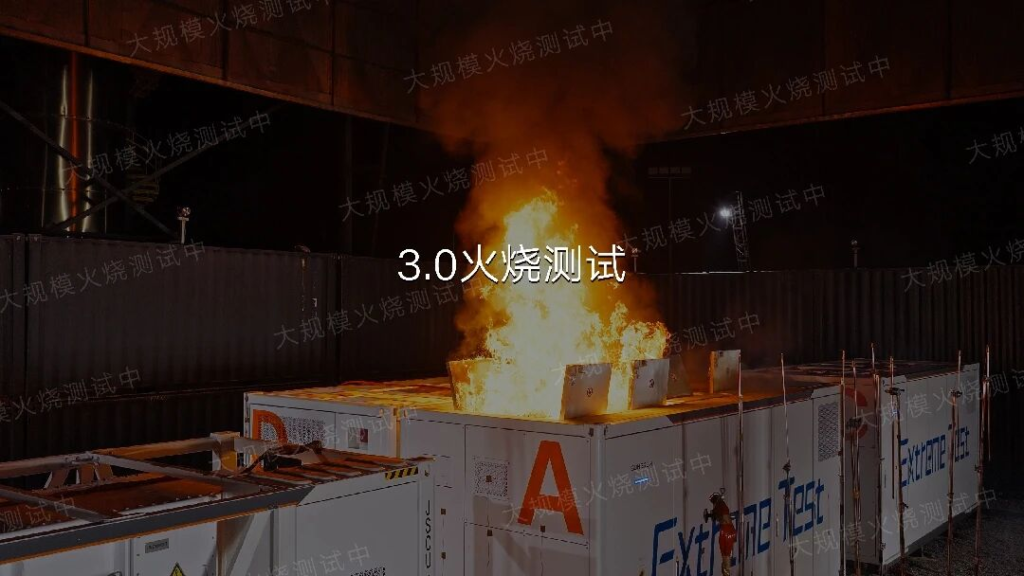
1. Why Does Large-Scale Fire Testing Matter?
According to Sungrow’s published test information, the test involved a 28.56 MWh fully liquid-cooled energy storage system and a 7.4 MW medium-voltage substation, arranged to replicate the block-level layout of a utility-scale BESS installation.
The test was conducted in accordance with the latest applicable requirements of UL 9540A:2026 and CSA/ANSI C800-2025.
- The conditions were deliberately severe:
- The initiating battery container was at 100% state of charge (SOC).
- Active fire suppression and thermal management systems were disabled.
- Explosion relief panels were fully open.
- The fire test continued for 7.5 hours.
During the test, the initiating container reached a peak internal temperature of 1,259.8°C.
According to Sungrow’s reported results, the fire remained within the initiating container, with no propagation to adjacent containers or the medium-voltage substation. The highest cell temperature in adjacent containers remained below the applicable thermal runaway threshold.
The containers also retained their structural integrity. Sungrow reported that the initiating container could be lifted as a complete unit after the test, while adjacent containers showed no structural deformation.
These results matter because a battery incident does not necessarily remain confined to the unit where it begins. Heat transfer and fire propagation can create additional risks for neighboring equipment and the wider site.
A large-scale test helps engineers evaluate how a system behaves under extreme conditions, rather than relying on individual component specifications alone.
Of course, a successful test does not mean every possible failure scenario has been eliminated. It provides evidence of system performance under the specific conditions tested.
2. Safety Starts Long Before the Test
One detail worth noting is that Sungrow reports successful first-time completion of large-scale fire tests across three generations of its PowerTitan product line: 1.0, 2.0, and 3.0.
Experience from earlier testing can help engineers better understand thermal runaway behavior, improve simulation models, and refine system designs.
For PowerTitan 3.0, Sungrow reported conducting hundreds of simulated scenarios before the physical fire test. According to the company, the predicted fire scale and progression showed strong agreement with the actual test results.
This is an important part of the process.
A physical test shows what happens under a particular set of conditions. Simulation allows engineers to explore additional scenarios that may be difficult, expensive, or impractical to reproduce in real life.
Neither approach is sufficient on its own. The real value comes from combining system design, simulation, physical testing, and continuous improvement.
For energy storage buyers, this raises a practical question: how much verifiable evidence can a supplier provide to support its safety claims?
Product specifications are important, but understanding how a system has been tested — and what those tests actually demonstrate — can be just as valuable.
3. What Does This Mean for Energy Storage Project Owners?
For developers, EPC contractors, and investors, fire safety has implications beyond equipment performance.
Insurance and Financing
Verified fire safety performance and supporting test documentation can help insurers, lenders, and investors assess project risks.
However, test results alone do not guarantee lower insurance premiums, more favorable financing terms, or higher project valuations. These outcomes depend on the specific project, its location, applicable requirements, and the assessments carried out by the relevant institutions.
The practical takeaway is simple: reliable technical documentation can support a more informed risk assessment.
Site Design and Risk Management
The arrangement, separation, and protection of battery units can influence how an incident affects the rest of an installation.
Large-scale fire testing can help engineers better understand these risks and inform project-level safety planning.
For buyers, it is worth asking suppliers not only how a system prevents incidents, but also how it is designed to limit the consequences if an incident occurs.
Long-Term Operational Reliability
An energy storage system is a long-term investment. Its value depends not only on the revenue it can generate, but also on how reliably it operates and how effectively operational risks are managed.
For projects in hot climates, including parts of the Middle East, safety should be evaluated alongside thermal management, environmental suitability, maintenance requirements, and local fire protection regulations.
No single test answers every project question. But better evidence helps buyers make decisions based on more than headline specifications.
4. Five Questions Worth Asking Before Choosing a BESS
When comparing energy storage solutions, I would encourage project owners to look beyond capacity, efficiency, and initial cost.
Here are five practical questions worth discussing with any potential supplier:
1. What independent test reports are available?
Ask which standards and test conditions the reports cover, and whether the results apply to the system configuration being proposed for your project.
2. How does the system manage thermal runaway?
Understand what measures are in place to detect abnormal conditions and limit the propagation of heat or fire between units.
3. What happens if active cooling or fire suppression becomes unavailable?
Ask how the system is designed to respond to failures in supporting safety systems, and what evidence is available to demonstrate its performance.
4. What documentation can be provided for insurers, EPC contractors, and local authorities?
Clear technical documentation can help different project stakeholders evaluate risks and understand the system’s safety design.
5. How will safety be maintained throughout the system’s operating life?
Consider monitoring, maintenance, inspections, emergency response procedures, and the availability of technical support — not just the conditions at commissioning.
The answers will vary by system and project. That is precisely why these questions should be addressed early, rather than after equipment selection.
Final Thoughts: Safety Should Be Demonstrated, Not Just Promised
Sungrow’s PowerTitan 3.0 fire test is a useful reminder that energy storage safety should be supported by evidence, not simply described in product brochures.
For anyone investing in BESS, the goal is not to find a system that claims to have zero risk. It is to understand the risks, evaluate the available evidence, and choose a solution with safety measures appropriate to the project.
At the end of the day, system performance determines what a storage project can deliver. Safety engineering helps determine how confidently that value can be delivered over time.
And for project owners, asking the right safety questions before making an investment can be just as important as comparing prices and expected returns.
Because in energy storage, the real value of safety lies not only in preventing incidents, but also in limiting their consequences when things go wrong.