Why EL Testing Detects Hidden Cracks on Solar Panel Cells
Two core inspection procedures are mandatory on every solar panel manufacturing production line: EL testing and IV testing. IV testing serves as the final inspection to verify whether the power output of a complete solar panel meets factory delivery standards. However, IV testing only measures the overall power of the whole solar panel and cannot pinpoint flaws such as microcracks or broken grid lines on individual solar panel cells. In contrast, EL imaging visualizes internal defects, exposing invisible faults hidden inside each solar panel module.

Functions of EL Testing
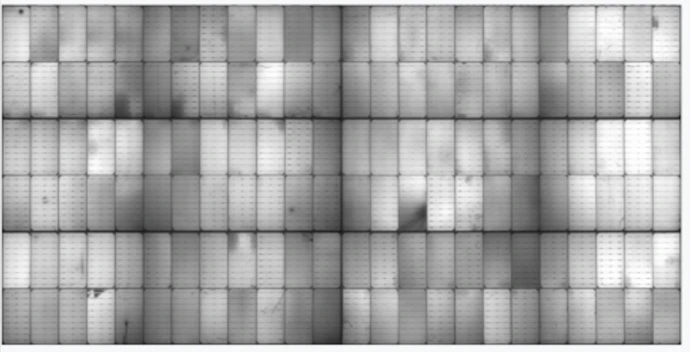
EL testing conducts qualitative and positional analysis on all solar panel cells inside a solar panel assembly, identifying various microstructural defects of solar panel components. Detectable flaws include hidden microcracks, broken cell fragments, disconnected grid lines, cold solder joints, detached solder joints, surface contamination, poor sintering quality, and inconsistent conversion efficiency across solar panel cells.
## Working Principle of EL Testing
The power generation logic of solar panel cells has been covered in previous articles. Each solar panel cell is constructed with P-type and N-type semiconductor materials. When P-type and N-type semiconductors bond to form a PN junction, a built-in electric field generates at the contact surface. Under sunlight irradiation, photon energy excites electron-hole carrier pairs. Electrons migrate toward the N-region while holes drift to the P-region, triggering charge separation and generating electric power for the solar panel.
Any defect obstructing the transmission of electric current (namely electron and hole carriers) will be captured by EL scanning for solar panel inspection. Below are typical defects commonly spotted during solar panel EL inspection:
1. Hidden Microcracks on Solar Panel Cells
Hidden microcracks refer to tiny fractures inside solar panel cells invisible to the naked eye. Although undetectable by human vision, these cracks form an impenetrable barrier for microscopic carriers (electrons and holes). Carrier transmission gets fully blocked at cracked sections, which eliminates radiative recombination and photon emission. These blocked zones appear as distinct black lines on EL scans of the solar panel.
2. Cold Solder Joints on Solar Panel Cells
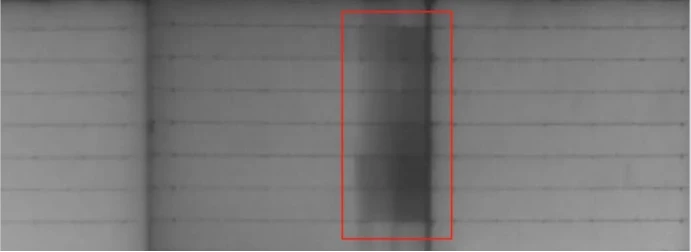
Cold solder joints show up as uneven dark spots or fragmented dark streaks along grid lines on solar panel EL images. The root cause lies in failed metallic bonding between solder ribbons and cell grid lines, which drastically raises contact resistance. Current flow is severely restricted within cold solder areas, preventing carriers from passing through the solar panel cell normally. The luminous intensity of defective zones drops sharply, creating obvious dark patches that stand out against intact areas of the solar panel.
3. Broken Grid Lines of Solar Panel Cells
Broken grid lines occur when thin front-side grid traces snap or separate from the solar panel cell substrate. Electric current fed from main busbars cannot reach disconnected thin grid segments, nor can current on thin grids flow into the internal PN junction of the solar panel cell. The PN junction at broken grid locations carries minimal or zero current density, resulting in weak or zero luminescence and marked grid failure defects on solar panel EL images.