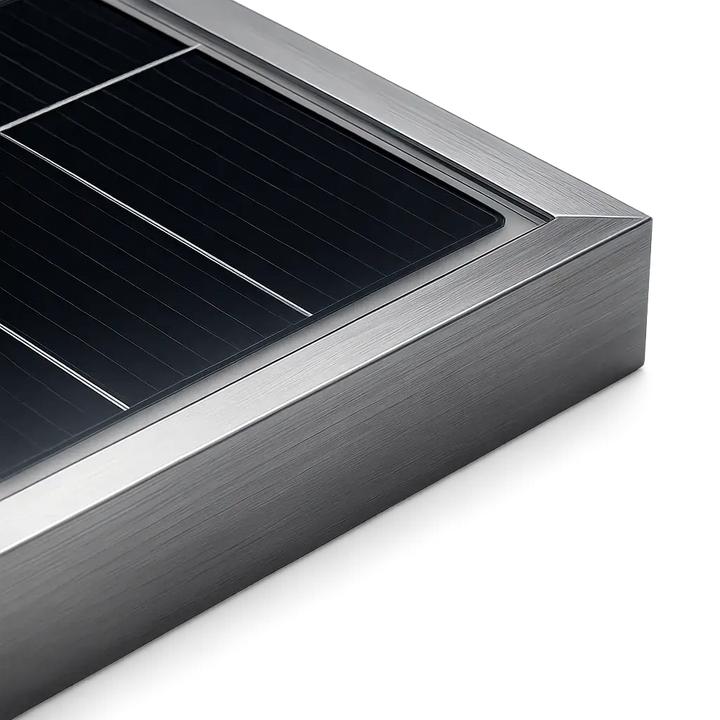
When choosing solar panels, most buyers pay attention to power output, efficiency, and price. The frame is often overlooked.
But think about it: a solar panel is expected to work outdoors for more than 25 years. Its frame has to deal with wind, rain, humidity, temperature changes, and sometimes even harsh coastal conditions.
For a long time, aluminum has been the standard material for solar panel frames. But things are starting to change. Zinc-aluminum-magnesium steel and fiberglass composite materials are giving the industry more options.
So, is aluminum still the best choice? Or are these alternatives worth considering?
Let’s look at what really matters.
1. Aluminum: A Proven Choice, But Not the Only One
There is a reason aluminum frames have dominated the solar industry for so many years.
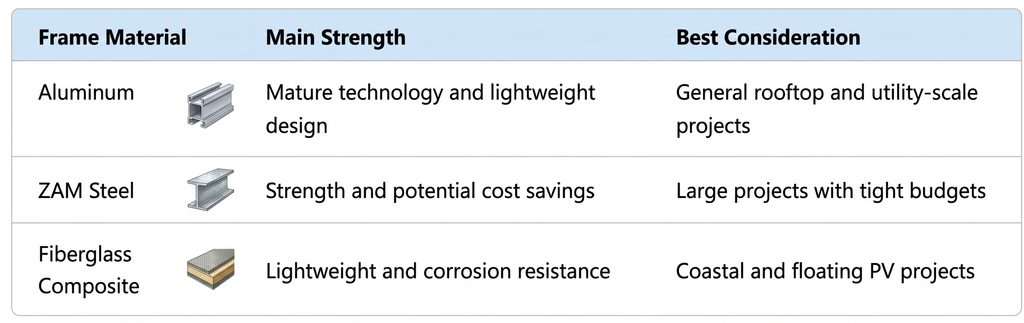
They are lightweight, easy to manufacture, corrosion-resistant with proper surface treatment, and supported by a very mature supply chain.
For module manufacturers, aluminum is also convenient because existing production lines and installation processes are already well established.
For most conventional solar projects, it remains a dependable choice.
However, module prices have become increasingly competitive. When every cent per watt matters, manufacturers and buyers naturally start looking at other ways to reduce costs.
That is where steel frames come into the picture.
[Insert Image 2: Aluminum solar panel frame profile]
2. Steel Frames: More Than Just a Cheaper Alternative
Zinc-aluminum-magnesium (ZAM) steel frames are attracting growing attention in the PV industry.
Unlike ordinary steel, ZAM steel has a special protective coating designed to improve corrosion resistance, including protection around cut edges.
Steel also offers higher mechanical strength, which allows manufacturers to optimize frame thickness and structural design.
The potential cost advantage is another reason behind its growing interest.
But there are a few things buyers should not overlook.
Steel frames are generally heavier than aluminum ones. Grounding connections need to be compatible with the frame design, and corrosion resistance should be evaluated through proper testing.
In other words, a lower material cost does not automatically mean a better overall solution.
For large ground-mounted solar projects, however, steel-frame modules can be an interesting option, especially when the project has strict budget requirements.
[Insert Image 3: Zinc-aluminum-magnesium steel frame]
3. Fiberglass Composite: A Different Direction
While steel focuses largely on strength and cost, fiberglass composite frames offer something different.
They are lightweight, electrically insulating, and resistant to conventional metal corrosion.
This makes them interesting for floating solar, coastal installations, and projects exposed to high humidity or salt mist.
There is also a sustainability angle.
Covestro reported in June 2025 that PV module shipments using its polyurethane composite frame technology had exceeded 3 GW.
Still, composite frames have some challenges. Long-term performance data, recycling solutions, and manufacturing costs all need further development.
It is a promising technology, but not necessarily the right choice for every project today.
[Insert Image 4: Fiberglass composite solar frame]
4. Which Solar Panel Frame Is Right for Your Project?
Honestly, I don’t think there is one material that can replace all the others.
It depends on what the project actually needs.
For buyers, I would suggest looking beyond the frame material itself.
Check the complete module’s mechanical load ratings, corrosion test results, grounding design, warranty, and actual weight.
A frame that looks cheaper on paper may not be the most economical choice after transportation, installation, and long-term maintenance are considered.
5. A Small Detail Worth Paying Attention To
Recently, we have also been paying more attention to steel-frame module options in our JA Solar supply chain.
For customers looking at different power ranges, JA Solar 610W, 620W, and 625W steel-frame modules currently have some special pricing opportunities, subject to model and stock availability.
If you are comparing module options for an upcoming project, it may be worth adding them to your quotation list.
[Insert Image 5: Actual JA Solar steel-frame module photo]
Final Thoughts
The solar industry is changing, and even components that once seemed standard are being reconsidered.
Aluminum still has a strong position. Steel is creating new opportunities for cost optimization, while composite materials are opening up possibilities in more demanding environments.
For project developers and module buyers, the important question is not simply which material is better.
It is which one makes more sense for your project, your location, and your long-term investment.
Sometimes, the smallest details are worth a closer look.
Frequently Asked Questions
Q1: Are steel-frame solar panels better than aluminum-frame solar panels?
Not necessarily. Steel frames offer higher mechanical strength and potential cost advantages, while aluminum frames are lighter and have a more established supply chain. The best choice depends on project requirements and environmental conditions.
Q2: Are zinc-aluminum-magnesium steel frames resistant to corrosion?
Zinc-aluminum-magnesium coatings provide enhanced corrosion protection compared with ordinary uncoated steel. However, actual performance depends on coating quality, processing, installation, and environmental exposure.
Q3: What should I check before buying steel-frame solar panels?
Check the exact module model, frame specifications, mechanical load ratings, corrosion test results, grounding design, warranty, and applicable certifications.