How Much Do Solar Panels Cost for a Commercial Building? A 2026 Guide
Solar panels for commercial buildings are a major investment. Knowing the costs up front can help you make a smarter decision.
Commercial solar panels cost $2.50 to $3.50 per watt before incentives, with prices dropping to $1.20 to $1.75 per watt after tax credits and rebates.
For most businesses, that means total system costs can range from $37,500 for a small retail shop to well over $1 million for big industrial facilities.
What you pay depends on a bunch of things—building size, energy usage, location, and installation complexity all matter here.
Your business could see electricity bill reductions of up to 75%. Many commercial solar systems pay for themselves within 3 to 7 years.
Federal tax credits, state incentives, and accelerated depreciation can seriously cut down your upfront investment.
This guide dives into commercial solar costs for 2026. We’ll cover what drives pricing differences, ways to maximize incentives, and what you might run into during installation.
Key Takeaways
- Commercial solar installation costs run from under $40,000 for small businesses to over $1 million for large facilities, depending on system size and energy needs
- Federal tax credits and state incentives can chop your total solar costs by 50% or more, with payback periods usually between 3 and 7 years
- Your final price hinges on roof type, location, panel quality, and whether you buy, lease, or finance the system
Commercial Solar Panel Costs: Key Figures and Cost Breakdown
Commercial solar panel costs usually land between $2.50 and $3.50 per watt before incentives. The total investment changes based on your business size and energy needs.
Your overall cost covers equipment, installation labor, and all the extras like permits and inspections.
Average Cost per Watt and System Size Ranges
Most companies pay $2.50 to $3.50 per watt for commercial solar panel installation before incentives. After federal tax credits and local incentives, the price drops to $1.20 to $1.75 per watt.
The system size you’ll need depends on your business type and electricity usage. Small retail shops usually need 15 to 25 kW systems. Medium offices often require 26 to 50 kW.
Warehouses and commercial farms install 51 to 100 kW systems. Large facilities like schools and hospitals might use 101 to 250 kW systems.
Industrial factories and shopping malls sometimes need 300 to 350 kW or even bigger setups. Your system size is the biggest factor in your total solar installation costs.
Total Installed Cost by Business Type
Your total commercial solar system cost changes a lot depending on your facility’s energy demands. Small businesses with 15 to 25 kW systems pay $37,500 to $87,500 before incentives, or $18,000 to $43,800 after tax credits.
Medium-sized retail stores and offices with 26 to 50 kW systems spend $65,000 to $175,000 upfront, dropping to $31,200 to $87,500 after incentives.
Warehouses needing 51 to 100 kW face costs of $127,500 to $350,000 before credits. Large facilities with 101 to 250 kW systems invest $252,500 to $875,000, or $121,200 to $437,500 after incentives.
Extra-large installations of 300 to 350 kW for shopping malls or factories cost $750,000 to $1,225,000, and fall to $360,000 to $612,500 with federal tax credits.
Cost Breakdown: Equipment, Labor, and Soft Costs
Solar panels themselves make up about 40% of your total commercial solar panel installation cost. This covers the photovoltaic modules that turn sunlight into electricity for your building.
The balance of system parts—like inverters, mounting structures, cables, wiring, and electrical panels—take up about 36% of the cost.
Installation labor usually makes up the last 24%. That’s the team mounting panels, running electrical, and tying the system into your building’s power. Your actual percentages might shift depending on your location, roof, and how tricky your project is.
Other soft costs include permits, inspections, interconnection fees, and insurance updates. These can really vary depending on where you are.
Major Factors Impacting Commercial Solar Cost
Plenty of factors affect what you’ll pay for commercial solar panels. System size, equipment quality, installation complexity, and local market conditions all play a part.
System Size and Energy Requirements
Your system size directly drives your cost. Commercial solar systems typically range from 50 kW for small businesses up to over 1 MW for bigger facilities.
Larger systems get you some economies of scale. You’ll usually pay less per watt as the system size goes up.
A 100 kW system might run $2.00 per watt, while a 500 kW system could drop to $1.66 per watt. Your energy use tells you what size you’ll need, so it’s smart to check your electricity bills from the past year to spot usage patterns.
Buildings that use a lot of energy need more panels and supporting equipment. If you’re tight on roof space, you might need higher-efficiency panels or even look into solar carports or ground-mounted arrays.
Equipment Quality and Technology Choice
Equipment quality matters for both your upfront cost and long-term performance. Commercial solar panels come in three main types, each with their own price and efficiency.
Monocrystalline panels cost the most but offer 20-23% efficiency. These are great if you’re short on roof space or want maximum power.
Polycrystalline panels give you 15-17% efficiency at a lower price. Thin-film panels are the cheapest option, but only deliver 10-12% efficiency.
Your inverter choice also affects cost. String inverters are the most budget-friendly for simple installs. Microinverters cost more but work better if you’ve got shading or a tricky roof layout.
Ballasted racking systems don’t require much roof penetration but add weight. Fixed-tilt racking costs less than tracking systems, which follow the sun and boost energy production by 15-25%.
Installation Complexity and Site Conditions
Solar engineering requirements change based on your building. Older roofs might need reinforcement to handle the panel weight, which tacks on structural costs before you even get started.
Solar permitting can be a headache in some places. Some cities and states want tons of documentation and inspections, which bumps up your soft costs.
Your commercial solar contractors need to know local building codes and utility rules. Roof type matters too—flat roofs make installation easier but might need ballasted systems. Sloped metal roofs are pretty simple, but tile or older roofs need extra care.
Connecting your system to the utility grid isn’t always straightforward. Utility interconnection fees range from a few hundred to several thousand bucks. Your solar panel installer handles this with the utility company.
Site accessibility can change labor costs a lot. Ground-level or easy-to-reach roofs are cheaper to work on than high-rise buildings that need special equipment.
Regional Labor Rates and Market Variability
Labor rates jump all over the map depending on where you are. Commercial solar companies in cities like New York or San Francisco charge more than installers in rural spots.
Local competition matters, too. Areas with lots of commercial solar contractors usually have better rates, while places with fewer options might see higher prices.
State and local incentives can make a big difference. Some states throw in extra rebates or tax credits on top of federal programs.
Electricity rates in your area affect your savings potential. Higher local utility rates make commercial solar more attractive, even if you’re paying a bit more up front. If you’ve got lower electricity costs, your payback period might stretch out, but solar still brings long-term value.
Solar Financing, Incentives, and Tax Benefits for Businesses

Federal tax credits, accelerated depreciation, and renewable energy certificates can shave 30-70% off your commercial solar costs. How you finance—buying, leasing, or going for a power purchase agreement—decides which incentives you get and shapes your long-term savings.
Investment Tax Credit (ITC) and Federal Incentives
The federal Investment Tax Credit (ITC) gives you a 30% tax credit on your total solar installation cost through 2032. This covers equipment, labor, permitting, and even sales tax.
Install a $500,000 system, and you get a $150,000 tax credit that comes right off your federal tax bill. You can bump the base 30% ITC up with bonus credits. The Domestic Content Bonus adds 10% if you use American-made solar panels and components.
The Energy Community Bonus adds another 10% for projects in former coal communities or areas with retired fossil fuel facilities. You need to own the solar system to claim the ITC.
The credit requires enough tax liability to use it fully, but you can carry unused credits back one year or forward up to 20 years. Your system has to stay up and running for five years, or you risk paying some of the credit back.
The REAP Grant helps agricultural and rural businesses with grants covering up to 50% of project costs. This USDA program can provide up to $1 million per project and can be stacked with the ITC, though the grant amount lowers your depreciable basis.
Depreciation, RECs, and Local Incentives
MACRS depreciation lets you recover your solar investment over five years with accelerated depreciation. This benefit works with the ITC, though the ITC reduces your depreciable basis by half the credit amount.
For a $500,000 system with a $150,000 ITC, you depreciate $425,000 instead of the full cost.
Bonus depreciation lets you deduct 60% of the remaining basis in year one (2024-2025). This percentage drops in future years.
This accelerated schedule gives you strong first-year tax benefits and can make cash flow easier.
Renewable Energy Certificates (RECs) represent the environmental benefits of your solar production. You can sell these for extra revenue—usually $5-$50 per megawatt-hour, depending on your market.
Some states offer Solar Renewable Energy Credits (SRECs) that trade at higher prices in SREC markets.
State and local incentives depend on your location. North Carolina offers renewable energy credits under its portfolio standard.
South Carolina provides extra state tax credits with annual caps. Georgia exempts solar equipment from sales tax, so you pay less up front.
Financing Options: Loans, Leases, and PPAs
Cash Purchase
- You own the system and get all tax benefits
- Highest long-term return on investment
- Requires significant upfront capital
- Full ITC and depreciation benefits
Solar Loans
- You own the system and pay over time
- Claim the ITC and MACRS depreciation
- Interest rates usually range from 4-8%
- No upfront cost with some loan programs
Solar Leases
- The leasing company owns the system and claims tax benefits
- You pay fixed monthly payments for 15-25 years
- Monthly costs are usually lower than pre-solar utility bills
- No maintenance responsibilities
Power Purchase Agreements (PPAs)
- You buy power from the system owner at a set rate
- No upfront investment required
- Rate is usually below utility prices
- Developer claims the ITC and depreciation
Your tax situation really shapes your best option. If you have enough tax liability, owning through cash or loans gives you the most benefits. Not enough tax appetite? Solar leases or PPAs still give you savings, and you skip the hassle of monetizing tax incentives.
How Net Metering and SRECs Affect Costs
Net metering credits you for excess solar power sent to the grid at retail rates. If your panels produce more than you use, your meter runs backward.
These credits offset the power you pull from the grid at night or when production is low.
Net metering policies change by state and utility. Some match retail rates one-to-one, while others pay wholesale for excess generation.
Time-of-use net metering values electricity based on when you generate it, with higher credits during peak demand hours.
SREC markets create ongoing revenue streams in certain states. You earn one SREC for each megawatt-hour your system produces.
States with solar requirements create demand for these certificates, driving prices up. Massachusetts, New Jersey, and Pennsylvania have active SREC markets where certificates trade for $20-$300 each.
A 100 kW system making 130,000 kWh per year could generate $3,900-$39,000 in SREC revenue, depending on market rates. Net metering wipes out most of your electricity purchases, saving $13,000-$19,500 annually at typical commercial rates.
Commercial Solar Installation Process and Longevity
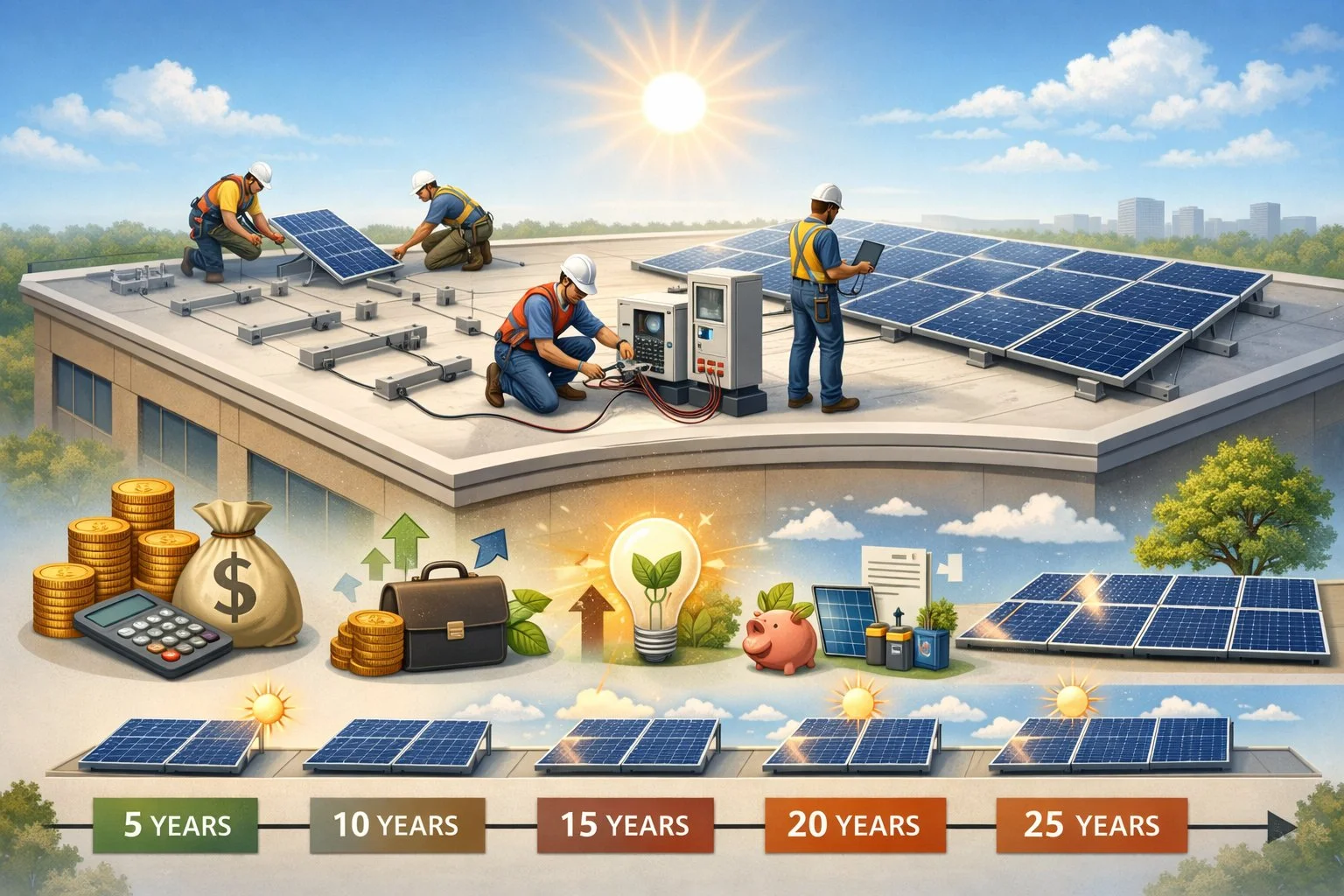
Commercial solar installations need careful planning, professional execution, and ongoing maintenance to make the most of your investment. Most commercial systems last 25 to 30 years with proper care, delivering decades of energy savings for your business.
Project Planning: Assessment, Engineering, and Permitting
Your commercial solar panel installation starts with a detailed site assessment. The installer checks your roof structure, available space, electrical system, and energy usage patterns.
They measure your property’s solar potential based on sun exposure, shading, and local climate.
Engineering teams design a system sized for your needs. They figure out the best panel placement—maybe on your roof, as a solar carport in your parking lot, or on ground-mounted arrays.
The design takes into account your current electricity use and possible future growth.
Permitting takes 2 to 8 weeks, depending on where you are. Your solar panel installer handles building permits, electrical permits, and utility interconnection agreements.
They also submit applications for federal tax credits and local incentives. Some places require extra environmental reviews or zoning approvals for bigger commercial systems.
Installation Methods and Labor Considerations
The actual installation usually takes 1 to 3 months for most commercial projects. Larger systems for warehouses, schools, or factories might need 3 to 6 months.
Labor makes up about 24% of your total commercial solar installation cost.
Installation crews mount the panels using methods that fit your building type. Flat roofs often use ballasted racking systems that don’t poke holes in the roof.
Sloped roofs need rail-mounted or rail-less systems secured right to the structure.
Your installer connects the panels to inverters, converting solar energy to usable electricity. They tie the system into your electrical panel and set up monitoring equipment.
Final inspections check that the installation meets electrical codes and safety standards before your system goes live.
Maintenance, Warranties, and Expected System Lifespan
Commercial solar panels last 25 to 30 years on average. Many systems keep producing electricity well beyond that.
Panel efficiency drops about 0.5% to 0.8% per year. After 25 years, your panels still work at about 80% to 85% of their original capacity.
Maintenance is pretty minimal, but don’t skip it. Plan to clean your panels once or twice a year at $10 to $20 per panel.
Annual inspections check for damage, loose connections, and inverter performance.
Equipment warranties protect your investment. Solar panels usually include 25-year performance warranties and 10 to 15-year equipment warranties.
Inverters come with 10 to 15-year warranties, though you’ll probably need to replace one during your system’s life. Many installers also offer workmanship warranties for installation defects for 5 to 10 years.
Frequently Asked Questions
Commercial solar costs depend on a bunch of things—system size, site conditions, and available incentives. Knowing these variables helps you budget and get the best return for your money.
What factors influence the cost of installing solar panels on a commercial property?
System size drives most of the cost for commercial solar installations. Bigger systems need more panels, racking, and electrical gear, so your total investment goes up.
Panel efficiency matters too. Higher-efficiency panels cost more, but you can cram more power into tight roof spaces.
Your mounting system changes the cost as well. Roof-mounted systems are usually cheaper than ground-mounted arrays, but tricky roofs can add engineering and hardware costs.
Labor rates shift by region and project complexity. Installing panels on a multi-story building or a facility with tough safety rules takes more time and skilled workers than a simple warehouse.
Your electrical setup affects how easily solar ties in. Older buildings might need panel upgrades, transformer changes, or extra protection equipment, which adds to your cost.
Permitting and interconnection requirements can be a headache or a breeze, depending on your location and utility. Some places have smooth processes, while others demand piles of paperwork and utility studies that bump up soft costs.
Can you provide a cost range for commercial solar panel systems based on building size or capacity?
Commercial solar systems in 2026 usually cost $1.40 to $1.80 per watt before incentives. A 100 kW system lands at about $140,000 to $180,000, while a 500 kW setup ranges from $700,000 to $900,000.
Most businesses spend $150,000 to $600,000 on their solar installations. The wide range comes from differences in system size, site complexity, and equipment choices.
Small commercial buildings with 25-50 kW systems often pay closer to the high end per watt. Fixed costs like engineering, permitting, and mobilization don’t shrink much for smaller projects.
Large industrial facilities installing 500 kW to 5 MW systems usually get lower per-watt pricing. These projects benefit from buying in bulk, standardized installation, and spreading fixed costs across more capacity.
Your actual cost depends on your energy consumption and how much space you have. A 200 kW system might fit one business perfectly but be too small for another with higher electricity needs.
What are the potential financing options or incentives available for commercial solar panel installations?
The federal Investment Tax Credit gives you a 30% tax credit for commercial solar projects started by July 4, 2026. Projects that start later face a phase-out or must be in service by December 31, 2027, to keep the benefit.
The One Big Beautiful Bill Act brought back 100% bonus depreciation for qualified solar property. You can deduct 85% of your system’s depreciable basis in the first year, which really helps your cash flow.
The IRS allows 5-year MACRS depreciation for qualified clean energy facilities placed in service after December 31, 2024. This schedule lets you recover costs faster than standard commercial property depreciation.
The USDA’s Rural Energy for America Program offers grants for eligible rural businesses. Applications in early 2026 face stricter reviews about farmland preservation, so it’s smart to consult early.
Many states offer property tax exemptions that cut your annual operating costs. These exemptions protect you from higher property taxes when you add solar equipment.
Renewable Energy Certificates can bring in extra revenue in some markets. Your system produces RECs as it generates electricity, which you can sell or use for sustainability goals.
Power Purchase Agreements let you install solar with no upfront cost. A third-party developer owns the system and sells you electricity at a fixed rate, but you don’t get the direct tax perks.
How does the scale of a commercial solar project impact the overall installation price per watt?
Larger systems usually get lower per-watt pricing because fixed costs spread across more capacity. Engineering, mobilization, safety planning, and permitting don’t scale up as fast as system size.
A 50 kW system might cost $1.80 per watt, while a 500 kW installation at the same site could drop to $1.45 per watt. The difference comes from economies of scale in both equipment and labor.
Buying in bulk cuts material costs on bigger projects. Developers can negotiate better deals on panels, inverters, and racking when ordering large amounts.
Construction gets more efficient with scale. Larger projects justify dedicated crews and better equipment staging, which can reduce downtime and coordination hassles that plague smaller jobs.
Industrial-scale projects still face unique costs that smaller systems avoid. Electrical infrastructure upgrades, complex interconnection, and strict safety rules can eat into some per-watt savings.
Your building’s physical quirks matter more than just the system size. A 200 kW installation split across several roof levels costs more per watt than the same capacity on a single flat roof with easy access.
What maintenance costs should be anticipated for commercial solar panel systems after installation?
Professional cleaning services usually charge anywhere from $10 to $30 per panel in 2026. Regular cleaning keeps efficiency losses from dust, dirt, and debris down—otherwise, you could lose up to 20% output.
Annual inspections run between $200 and $600 for most commercial systems. Inspectors look for problems with wiring, mounting, and inverters before you end up with downtime or a pricey repair.
Inverter replacement is the big-ticket maintenance cost. Most inverters last 10 to 15 years, and when it’s time, you might pay $5,000 to $30,000, depending on your system’s size and the type of inverter.
If you’ve added battery storage, that’s another maintenance layer. Battery replacements usually happen every 10 to 15 years and can cost anywhere from $10,000 to $100,000, depending on how much capacity you need.
Your actual costs really depend on your local environment. Facilities in dusty or polluted areas end up cleaning their panels more often than those in cleaner places with regular rain.
Monitoring systems let you spot performance issues early. Most modern setups include remote monitoring for a pretty minimal fee, so you can check production without always sending someone on-site.
How do energy savings from commercial solar panel installations compare to the initial investment over time?
Your payback period usually falls somewhere between 5 and 10 years for most commercial solar setups. Of course, that range really depends on your electricity rates, the size of your system, incentives you can snag, and how much sun your area gets.
You can figure out simple payback by dividing your net cost (after incentives) by your yearly electricity savings. Let’s say you install a $300,000 system, get $90,000 in federal credits, and save $30,000 a year on electricity—you’re looking at a 7-year payback.
Rising utility rates