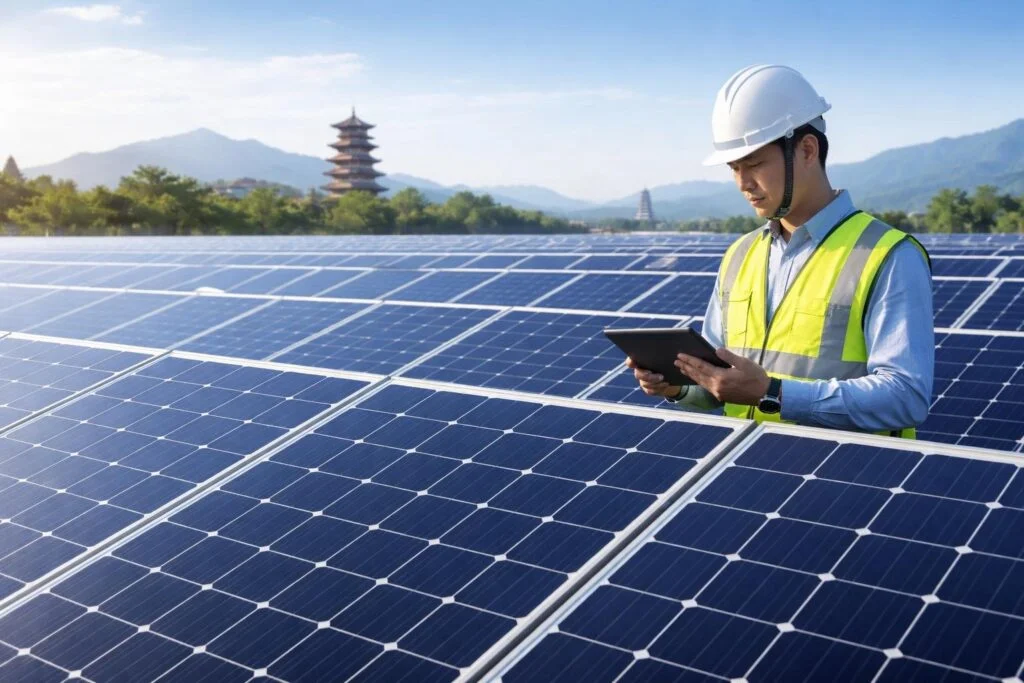
2026 China Solar Panel Supplier Guide: How to Source High-Quality PV Modules
China controls about 85% of global solar panel production capacity, making it the go-to source for businesses looking for photovoltaic modules in 2026.
China’s solar manufacturing dominance stretches across the entire supply chain, from polysilicon to finished modules. Major industrial clusters in Jiangsu, Zhejiang, and Guangdong provinces each offer their own mix of pricing, quality, and lead times.
Knowing where and how to source from these regions can really affect your project’s overall cost and long-term results.
For procurement managers, the real challenge isn’t finding suppliers—it’s picking manufacturers who deliver steady quality, proper certifications, and reliable after-sales support.
Chinese solar panel manufacturers range from world-famous Tier-1 brands to smaller, specialized producers. Each comes with its own trade-offs between cost and performance.
Your sourcing strategy needs to consider technical specs, compliance rules, and new factors like carbon footprint regulations that can tack on 8-12% to landed costs.
This guide walks you through the key decisions you’ll face when sourcing solar panels from China.
You’ll see how to look beyond price, navigate certification requirements, and sidestep quality defects that can mess with system performance over a 25-year lifespan.
Key Takeaways
- China’s top three solar manufacturing clusters each offer their own blend of price, quality, and production speed
- Proper supplier evaluation means checking certifications like IEC 61215 and knowing your materials to avoid costly defects
- Smart sourcing should factor in new compliance requirements, tariffs, carbon footprint rules, and tech shifts like PERC to n-type modules
China’s Solar Panel Manufacturing Landscape
China holds over 80% of global solar module production capacity in 2026. Manufacturing is concentrated in five main provincial clusters.
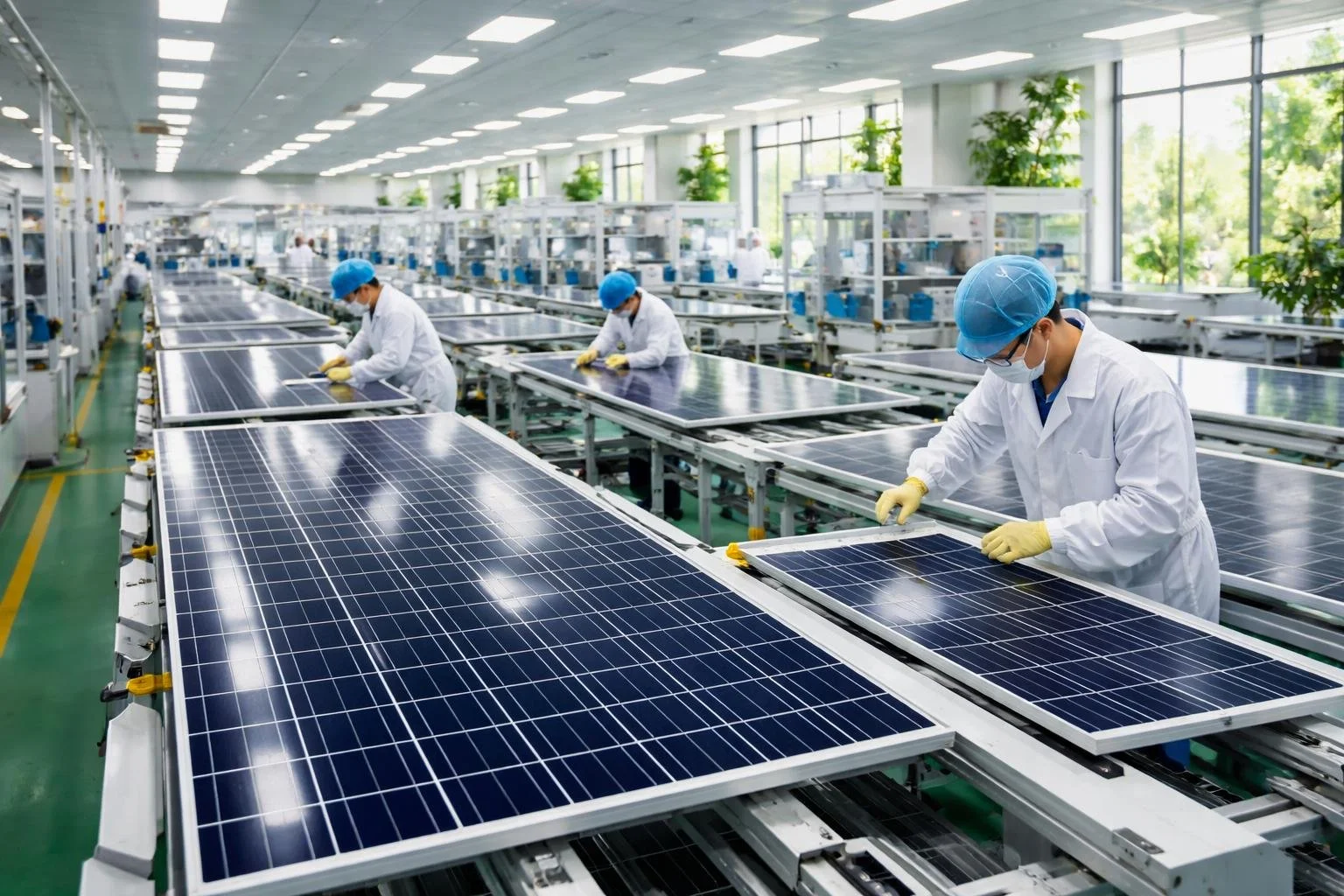
The country’s largest solar panel manufacturers run vertically integrated facilities that cover everything from polysilicon production to finished PV modules.
Key Production Regions and Industrial Clusters
Jiangsu Province is the global epicenter for premium solar panel manufacturing.
Changzhou, Wuxi, and Nanjing host a dense network of Tier-1 manufacturers. You’ll find Trina Solar, JA Solar, and Seraphim here, taking advantage of mature supply chains and advanced R&D.
Zhejiang Province focuses on cost-optimized premium production in Haining and Hangzhou. JinkoSolar and Canadian Solar run major plants here, tapping into the best supply chain density in China.
The region is known for monocrystalline PERC and TOPCon technologies.
Anhui Province handles high-volume production with government-backed mega-factories in Hefei and Huaibei. JinkoSolar’s Hefei operations and Risen Energy make modules for big utility projects.
Guangdong Province leads in building-integrated photovoltaic solutions and smart solar modules. Shenzhen and Dongguan offer access to electronics supply chains.
Leading Solar Panel Manufacturers in 2026
LONGi Green Energy, JinkoSolar, JA Solar, Trina Solar, and Canadian Solar sit at the top by production capacity.
LONGi specializes in high-efficiency monocrystalline silicon wafers and modules. JinkoSolar’s Tiger Neo series hits efficiency ratings over 22%.
Trina Solar’s Vertex series uses bigger wafer formats for more power. JA Solar runs 12 manufacturing bases with branches worldwide.
Canadian Solar keeps major operations in China despite its Canadian name.
Newer players like Aiko Solar, Tongwei Solar, DAS Solar, and Astronergy focus on next-gen tech like heterojunction (HJT) and tunnel oxide passivated contact (TOPCon) cells.
Suntech Power and Chint round out the top-tier group serving both domestic and global markets.
Vertical Integration and Supply Chain Dynamics
Major manufacturers control several production stages, from polysilicon to finished modules.
Companies like LONGi make silicon ingots, wafers, cells, and full PV modules all in-house. This approach trims costs and lowers quality risks.
The supply chain starts with polysilicon, then moves to ingot casting and wafer slicing. After that, manufacturers produce solar cells and assemble them into modules using photovoltaic glass, aluminum frames, and junction boxes.
China poured over $130 billion into solar manufacturing from 2023 to 2026, locking in its dominance at every stage.
Smaller manufacturers often buy components from specialized suppliers instead of making everything themselves. That leads to quality differences between vertically integrated Tier-1 producers and contract assemblers.
Check if your supplier makes core components in-house or buys them. That detail really matters.
Selecting Reliable Solar Module Suppliers
To choose the right supplier, you need to verify production capabilities with structured audits. Confirm international certifications like IEC 61215 and ISO 9001, and check their cell technology options, such as TOPCon or heterojunction cells.
Supplier Vetting and Factory Audits
Start your supplier vetting with documented proof of production capacity and financial stability. Ask for three years of production records to compare actual output to what they claim.
China produces over 80% of global solar panels, but not all suppliers are equally reliable.
Factory audits usually take 2-5 days and cover 150-400 checkpoints, depending on how deep you go. Check equipment maintenance logs, real throughput rates, and environmental controls.
Production areas should keep temperature within ±3°C and humidity between 40-60%.
Look closely at factory utilization rates. A 50-75% range means healthy operations with room to grow. Below 50% could be a red flag for quality or financial trouble. Over 80%? You might hit limits on custom orders.
Ask for documents like current order books, equipment specs with nameplate capacity, and third-party audit reports. Groups like SGS, Intertek, or TÜV Rheinland can handle independent checks.
Certification, Compliance, and Quality Control
Your supplier needs IEC 61215 certification for crystalline silicon module performance and IEC 61730 for safety.
These prove panels meet international standards. ISO 9001 shows they have quality management systems in place.
Look for ISO 14001 (environmental management) and ISO 45001 (occupational health and safety) too. Top Chinese manufacturers usually hold several certifications to meet global market rules.
Testing really matters for quality control. Suppliers should have:
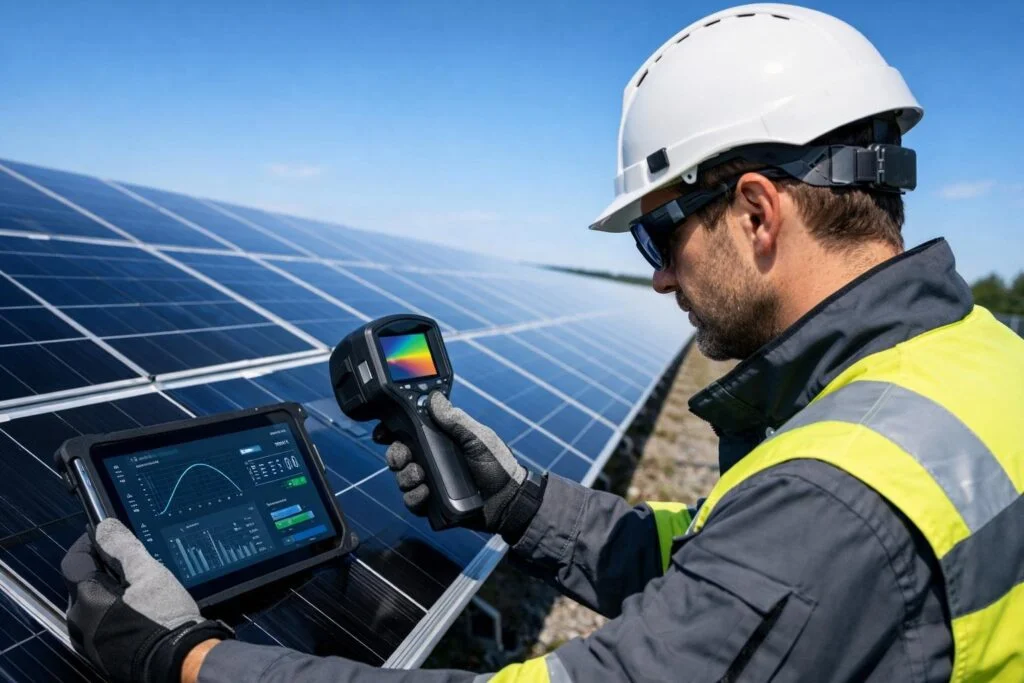
- Electroluminescence scanning to spot micro-cracks
- Flash testing to check power output
- Environmental chambers for thermal cycling (-40°C to +85°C)
- Damp heat testing (85°C, 85% humidity, 1000+ hours)
- Mechanical load testing (5400 Pa front load minimum)
Make sure suppliers use ISO 2859-1 inspection standards with strict quality limits: 0% for critical defects, 2.5% for major, and 4.0% for minor.
Technological Innovation and High-Efficiency Cells
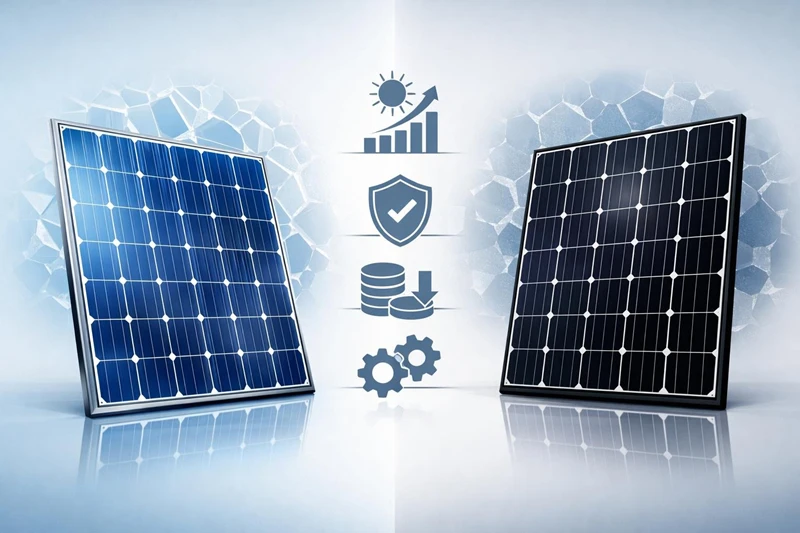
Modern suppliers offer a range of cell technologies with different efficiency levels. Monocrystalline PERC cells hit 20-22% commercial efficiency and are still widely available at good prices.
N-type TOPCon tech reaches 22-24% efficiency and handles heat better than standard monocrystalline silicon. It’s the main upgrade path right now for high-efficiency solar cells.
Heterojunction (HJT) cells get up to 23-25% efficiency using advanced processes. They combine crystalline silicon with thin-film layers, but tend to cost more than TOPCon or PERC.
Ask about the supplier’s cell efficiency ratings and which technologies they can produce at scale. Always check commercial production efficiency, not just lab numbers.
Make sure they can handle both 182mm and 210mm wafer sizes, since those are the big trends right now.
Check if suppliers invest in R&D and keep upgrading their production lines. Those who do usually offer better long-term value.
Navigating Sourcing Strategies and Export Regulations

China’s solar export landscape changed fast in early 2026 with new tax policies directly hitting procurement costs.
Your sourcing strategy has to factor in these regulatory shifts, supply chain risks, and changing price structures if you want your project to stay bankable.
Trade Policy Updates and Export Tax Rebate Changes
China eliminated all VAT export rebates for photovoltaic products starting April 1, 2026.
This policy covers 249 solar-related products, including cells, modules, and inverters.
The rebate cancellation adds about 3-5% to your landed costs. Suppliers who used to benefit from 13% VAT rebates now pass those costs along to buyers.
Expect price increases of $0.008-$0.012 per watt on standard modules.
Key pricing impacts include:
- Modules: Cost increases of 3.2-4.8%
- Inverters: Price adjustments of 2.8-4.1%
- Mounting systems: Material cost rises of 3.5-5.2%
Review any contracts signed before April 2026. Many suppliers have activated price adjustment clauses tied to this policy change.
If you’re planning large-volume purchases, try to negotiate fixed pricing that factors in the rebate elimination. This helps protect your project’s levelized cost of energy calculations, though it’s not always easy to get suppliers to agree.
Supply Chain Resilience and Risk Management
Your supply chain resilience really depends on diversifying suppliers across different manufacturing clusters.
China’s key solar manufacturing regions include Jiangsu, Zhejiang, Anhui, and Guangdong. Each region specializes in different parts of the production process.
Build relationships with at least two qualified suppliers in different provinces. That way, you’re less exposed to regional disruptions, inconsistent quality, or logistics headaches.
For utility-scale projects that need bankability, it makes sense to prioritize Tier-1 suppliers in Jiangsu or Anhui. They’ve got solid track records in similar installations.
Risk mitigation strategies:
- Ask for 60-day inventory buffers for critical components
- Check supplier financial stability using annual reports
- Line up backup suppliers with pre-negotiated pricing
- Keep an eye on production capacity versus your orders
Your EPC contractor should double-check supplier choices based on energy yield warranties and performance guarantees. Suppliers offering 25-year linear power warranties with a max of 0.55% annual degradation tend to deliver better long-term value for LCOE optimization.
Supplier Negotiation and Pricing Dynamics
After the rebate changes, you need to negotiate on more than just per-watt cost. Volume commitments now matter a lot more since suppliers lost their tax perks.
Try to lock in quarterly purchase agreements for orders over 10 MW. This gives you some pricing stability and helps suppliers plan production.
Suppliers are now asking for 40-50% upfront payments, up from the old 30% deposit, as they deal with cash flow without rebates.
Negotiation leverage points:
| Factor | Your Advantage | Target Outcome |
|---|---|---|
| Volume | Orders >20 MW | 2-3% price reduction |
| Payment terms | LC at sight | 1-2% discount |
| Delivery schedule | Flexible timing | Priority production slots |
Ask for detailed cost breakdowns that separate material, labor, and overhead. This lets you see exactly where the rebate elimination bites and gives you room to negotiate specific cost items.
Keep an eye on currency swings between your local currency and CNY. A 2-3% favorable exchange rate can offset rebate-related cost increases. Some suppliers will offer USD-denominated contracts to take currency risk off your plate.
Optimizing Project Integration and After-Sales Considerations

Getting solar installations right means thinking beyond just buying the panels. Equipment matching and long-term support matter a lot.
String inverter compatibility, battery storage integration, and warranty enforcement all shape your system’s 25-year performance. It’s a lot to juggle, honestly.
System Integration and Energy Storage Solutions
Your PV modules have to work smoothly with the rest of your solar equipment. When buying from Chinese suppliers, double-check that their panels integrate with your energy storage and existing setup.
Battery storage pairing needs specific voltage and current specs. Most Chinese manufacturers now make modules that work with lithium-ion battery banks from 5kWh up to 500kWh for commercial use.
Ask for technical specs showing DC coupling compatibility and charge controller requirements. Don’t just take their word for it—get the details in writing.
Key integration checkpoints:
- Voltage window matches your inverter input range
- Power output aligns with battery charging capacity
- Temperature coefficients fit your climate
- Module size fits your mounting systems
If your solar farm is over 1MW, you’ll need detailed integration documentation. Tier-1 Chinese suppliers usually provide system design help, including shading analysis and electrical schematics.
Mid-tier manufacturers might only give you basic compatibility charts. They rarely offer much project development assistance.
Smart monitoring systems need communication protocols built into junction boxes. Make sure modules have the right data ports for real-time performance tracking.
Inverter Selection and Compatibility
Your inverter choice affects how efficiently your panels convert DC to AC power. Chinese panel suppliers often recommend certain inverter brands, but you should always verify compatibility yourself.
String inverters usually handle 8-12 panels per string, depending on voltage. Microinverters attach to each panel and work best for residential setups. Central inverters handle big utility farms with 500kW+ capacity.
Your supplier should provide MPPT voltage ranges for each module series. Don’t forget to ask for this info—otherwise, you’re guessing.
Compatibility requirements include:
- Maximum system voltage (usually 1000V or 1500V)
- Open circuit voltage in cold weather
- Short circuit current at peak sunlight
- Temperature coefficient matching
Ask your panel maker for inverter compatibility lists. Top Chinese suppliers often partner with Huawei, Sungrow, and Growatt for tested setups.
Some factories even do joint testing to certify specific panel-inverter combos. It’s worth asking about.
You’ll need detailed electrical specs showing IV curves at different temperatures. This helps your installer size inverters right and avoid power clipping losses.
Performance Verification and Ongoing Support
After-sales support varies a lot among Chinese solar panel suppliers. Nail down clear warranty terms and performance guarantees before you order anything.
Standard warranties are 12 years for materials and 25 years for power output. Tier-1 makers guarantee 84-87% of rated power after 25 years.
Ask for warranty documents in English, with clear claims procedures and response timelines. Don’t settle for vague promises.
Essential support requirements:
- Technical hotline with English-speaking engineers
- Replacement panel inventory in your region
- Performance testing protocols (flash test data)
- RMA process with defined timelines
Your supplier should provide electroluminescence (EL) test results showing no microcracks or cell defects. This proof of quality helps with future warranty claims.
Ongoing monitoring needs compatible software. Many Chinese manufacturers have their own apps for solar lighting and commercial installs. If you’re integrating with third-party energy management, ask for API access.
Set up escalation procedures for defective modules, including who pays shipping and how replacements work. Reputable suppliers keep replacement stock in major markets, so you don’t end up waiting months during a warranty claim.
Frequently Asked Questions
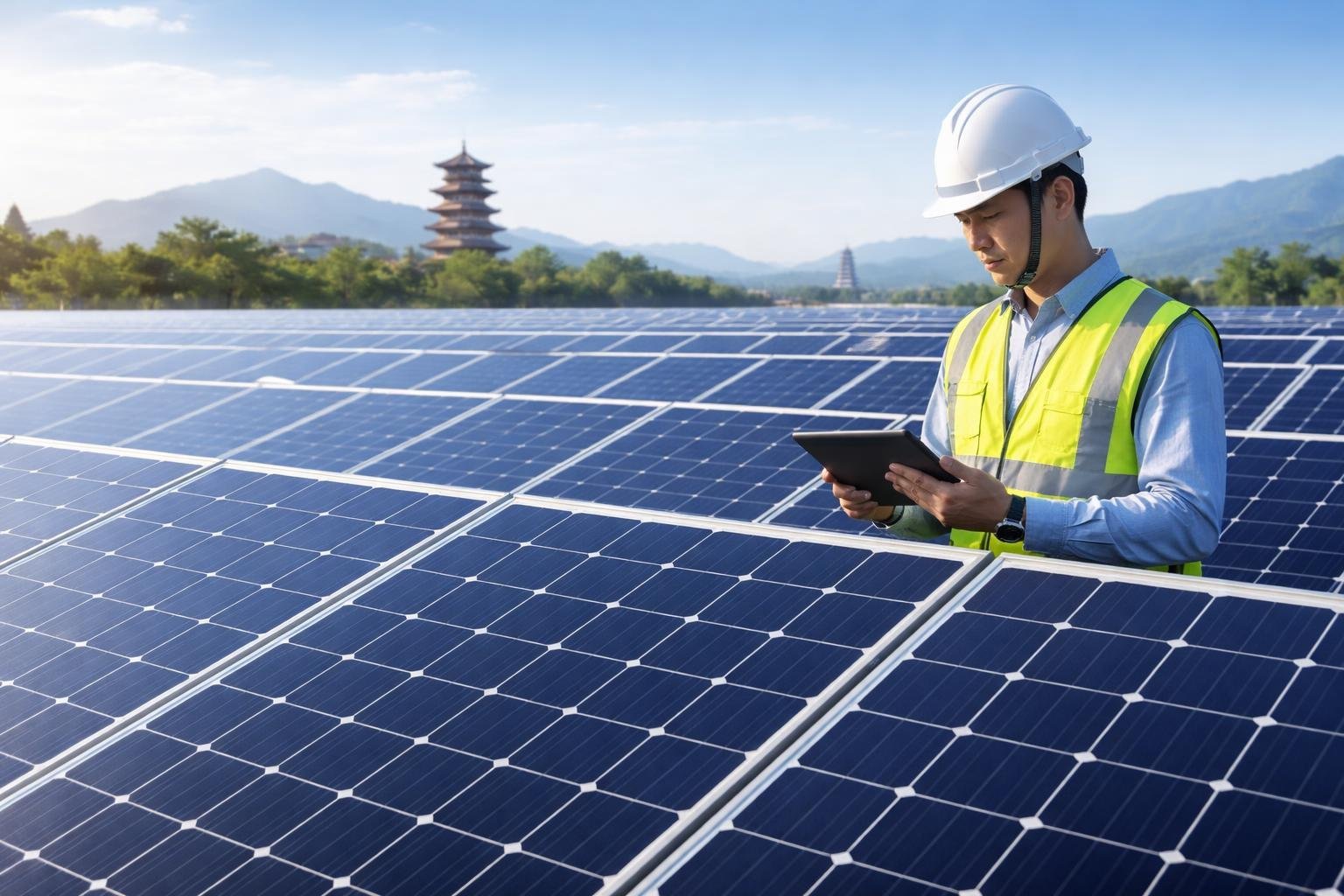
Buyers need to use specific methods for verifying certifications, get clear technical specs for different environments, follow structured audit protocols, include protective contract terms, set realistic timelines, and stay on top of import compliance.
How do I verify a Chinese solar panel supplier’s certifications and test reports before placing an order?
Ask for original certification documents directly from the issuing organizations—not just copies from the supplier. Key certifications include IEC 61215 for crystalline silicon module performance and IEC 61730-2 for safety.
Contact certification bodies like TÜV Rheinland, SGS, or Bureau Veritas to double-check certificate validity using the document number.
Request test reports that show actual measured values, not just pass/fail results. Review the scope of certification carefully; some suppliers only have certificates for certain models but claim coverage for their whole line.
Check that testing labs have ISO 17025 accreditation for the specific tests performed. Ask for electroluminescence scans, flash test results, and thermal cycling data for your exact module specification.
Make sure the supplier appears in the certification body’s public database. Most major certification companies have searchable online registries for valid certificates.
Which PV module specifications matter most for performance and reliability in different climates?
Temperature coefficient shows how much power output drops as panels heat up. For hot climates where panels hit 65°C or more, look for values around -0.35%/°C or better.
In humid coastal areas, choose modules with damp heat testing that goes beyond the standard 1000 hours at 85°C and 85% humidity. Frames with drainage holes help prevent corrosion from trapped water.
For cold climates, pick modules tested down to -40°C mechanical load. Wind and snow loads should meet 5400 Pa front load and 2400 Pa rear load standards.
Low-light performance matters in cloudy regions. Check the module’s performance ratio at 200 W/m² and 500 W/m², not just at standard 1000 W/m² test conditions.
TOPCon technology gives you 22-24% efficiency and better temperature coefficients than standard PERC. HJT modules reach 23-25% efficiency but, fair warning, they cost more.
Salt mist resistance (IEC 61701) is critical within 1 km of the ocean. Ammonia resistance matters for ag installations near livestock.
What factory audit steps help confirm consistent quality control and traceable bill of materials?
Start with a comprehensive factory audit. Depending on how complicated your order is, you might cover anywhere from 150 to 400 checkpoints.
Don’t just walk around the facility—dig into what the actual production equipment can do. It’s easy to get distracted by shiny floors or fancy displays, but you want real proof of capability.
Ask for maintenance logs. You’ll want to see calibration dates for critical testing equipment, especially flash testers.
Flash testers should get calibrated every 6-12 months. If they’re out of spec, power output measurements can be way off.
Check environmental controls in production areas. Cell handling needs temperature within ±3°C and humidity between 40-60% to avoid defects.
Look at the supplier’s incoming material inspection records for silicon wafers and cells. Traceability starts with batch numbers that actually link finished modules back to raw material suppliers.
Make sure they have documented procedures for isolating non-conforming products. You don’t want defective materials mixing with good inventory.
Walk through assembly areas and check for ESD protection. Electrostatic discharge can damage cells, even if you don’t see it right away.
Ask for supply chain documentation that proves material origins for UFLPA compliance. Complete traceability documentation must prove no Xinjiang content.
Insist on inspections that follow ISO 2859-1 standards. Set 0% acceptance for critical defects, 2.5% AQL for major defects, and 4.0% AQL for minor cosmetic issues.
Schedule pre-shipment inspection only after 100% of production is done and at least 80% of packaging is finished. Don’t cut corners here.
How should I structure an OEM/ODM contract to cover warranties, performance guarantees, and penalties for nonconformance?
Add specific liquidated damages clauses—usually 0.5-1% of the order value per week of delay. These amounts should be reasonable, or you’ll risk them being unenforceable.
Spell out performance warranties in detail. Most standard terms include 25-30 years of coverage, with max 2-3% degradation in year one and 0.55-0.7% annually after that.
Don’t just take the manufacturer’s word for it on warranties. Require insurance policies or bank guarantees to back them up, so you’re protected even if the supplier runs into financial trouble.
Define acceptance criteria with measurable values. Set power output tolerance at ±3% or tighter, and make sure cosmetic defect limits are clear.
Limit force majeure exclusions to truly unforeseeable events. Leave out peak demand, raw material price swings, and normal market changes.
If you need guaranteed production slots during peak season, include capacity reservation fees—usually 5-15% of annual order value. This helps your orders get priority when factories get busy.
Be clear about intellectual property ownership for your custom designs. Decide if you want exclusive rights or if the supplier can make similar products for others.
Make third-party inspections mandatory. Specify when they happen—during production at 30-50% completion, and again before shipment.
What are typical payment terms, lead times, and Incoterms when importing PV modules from China?
Most suppliers ask for a 30% deposit when you confirm your order. You’ll pay the remaining 70% before they ship your goods.
If a supplier wants 50% or more upfront, that’s usually a red flag for cash flow issues on their end.
Production for standard panels usually takes about 3-5 weeks if things are calm. But when demand spikes, you might wait 6-10 weeks instead.
Custom specs? Those take a bit longer—expect 5-8 weeks in normal times, and 8-12 weeks if it’s the busy season.
Busy periods hit in November and December (think holiday projects), and again from June to August for summer installs. Factories in China also shut down for Chinese New Year, which lands in late January or early February and lasts two to three weeks.
And don’t forget Golden Week—October 1st through 7th—when most manufacturing in China just stops cold.