B2B Solar Panel MOQ 2026: Wholesale Sourcing for Global Buyers
Buying solar panels in bulk? You’ll want to understand minimum order quantities (MOQs) and how they shape your costs and choices. Most manufacturers set MOQs between 100 and 1,000 panels for wholesale buyers, though a few factories will go as low as 100 pieces with delivery times of 15 to 25 days.
The 2026 wholesale solar panel market is shifting—pricing, tech, and supply chains are all moving targets that can make your purchasing decisions a bit more complicated.

Global supply chains for solar panels have gotten more tangled as manufacturers react to oversupply and new technology standards. You’ll need to juggle MOQ requirements, quality checks, compliance, and shipping headaches all at once.
Wholesale platforms can connect you straight to manufacturers. That way, you can negotiate better terms and sidestep extra fees from middlemen.
It’s crucial to understand how order volume affects pricing, manage relationships across regions, and stay on top of regulations. You’ll want practical steps to evaluate suppliers, negotiate MOQs, and lower your risks when sourcing panels internationally.
Key Takeaways
- MOQ requirements usually fall between 100 and 1,000 panels, but it depends on the manufacturer and how much customization you need.
- Volume pricing and direct supplier relationships can help you cut costs and avoid unnecessary fees.
- Double-check compliance and plan your logistics to protect your business from quality issues and delays.
Key MOQ Factors in B2B Solar Panel Procurement
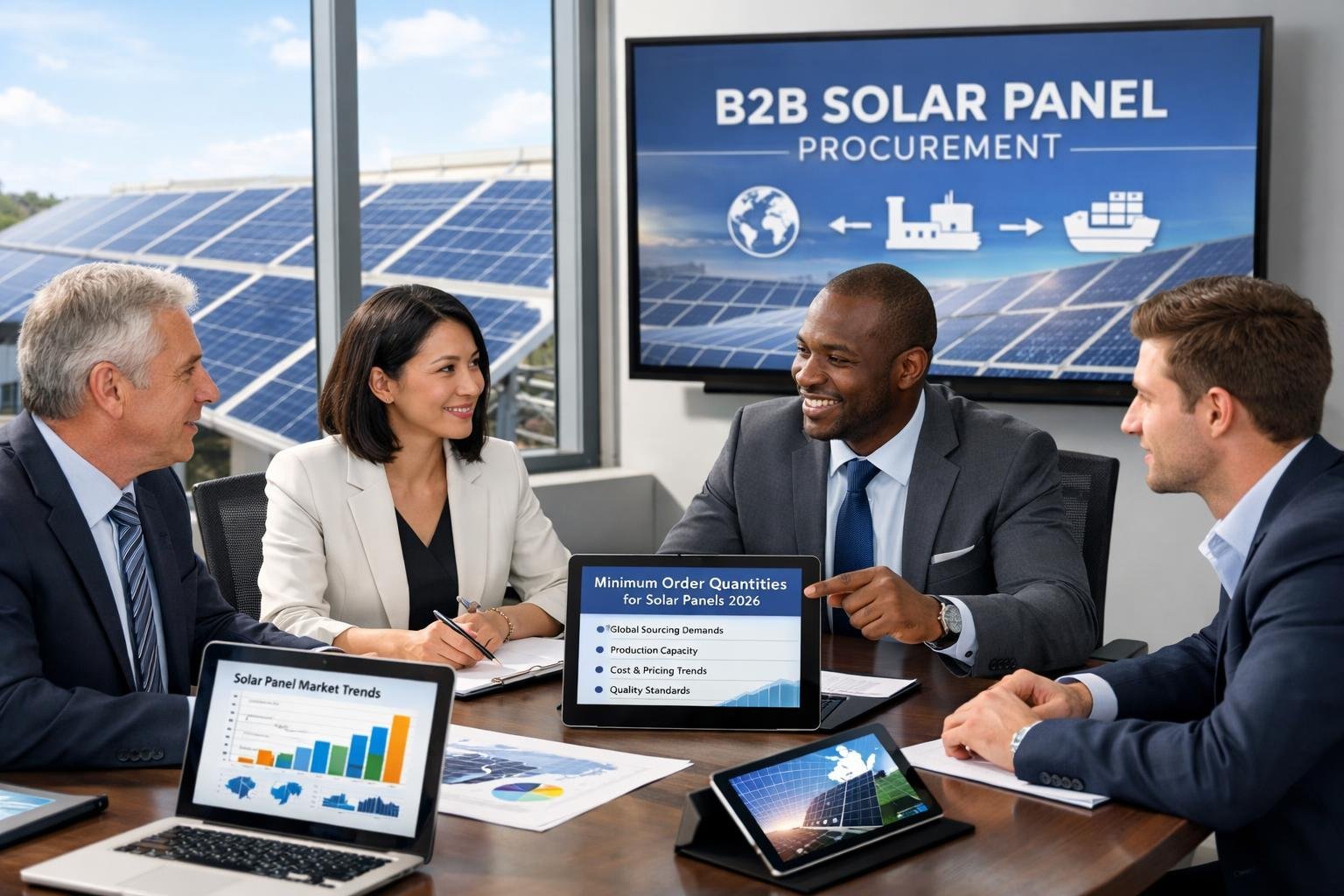
Manufacturers set their own minimum order rules based on the panel tech and how much they can produce. Testing protocols and delivery timelines hit your budget and project schedule directly.
Minimum Order Quantities by Manufacturer and Technology
MOQ requirements jump all over the place among Tier 1 solar manufacturers. Standard monocrystalline PERC panels usually need a full container—think 500 to 700 modules in a 40HQ container.
N-Type TOPCon panels often come with higher minimums. Specialized production lines drive that up.
Premium brands like Longi and Jinko stick to strict container-level MOQs for wholesale pricing. JA Solar and Trina Solar might cut you some slack if you’re already an established distributor.
Some suppliers offer custom solar panels with low MOQ starting at 100 pieces. But those are usually for niche projects, not big utility-scale stuff.
Container pricing nearly always beats pallet-level orders when it comes to cost per watt.
Typical MOQ ranges by order type:
- Full container (40HQ): 500–700 standard modules
- Half container: 250–350 modules, but expect to pay more per panel
- Custom specs: 100–500 pieces, varies by manufacturer
- Sample orders: 2–10 units for hands-on testing
Sample Testing and EL Testing Requirements
Always ask for sample modules before you commit to a big order, especially with a new supplier. Most manufacturers will send you 2–10 samples at close-to-wholesale prices so you can check them out.
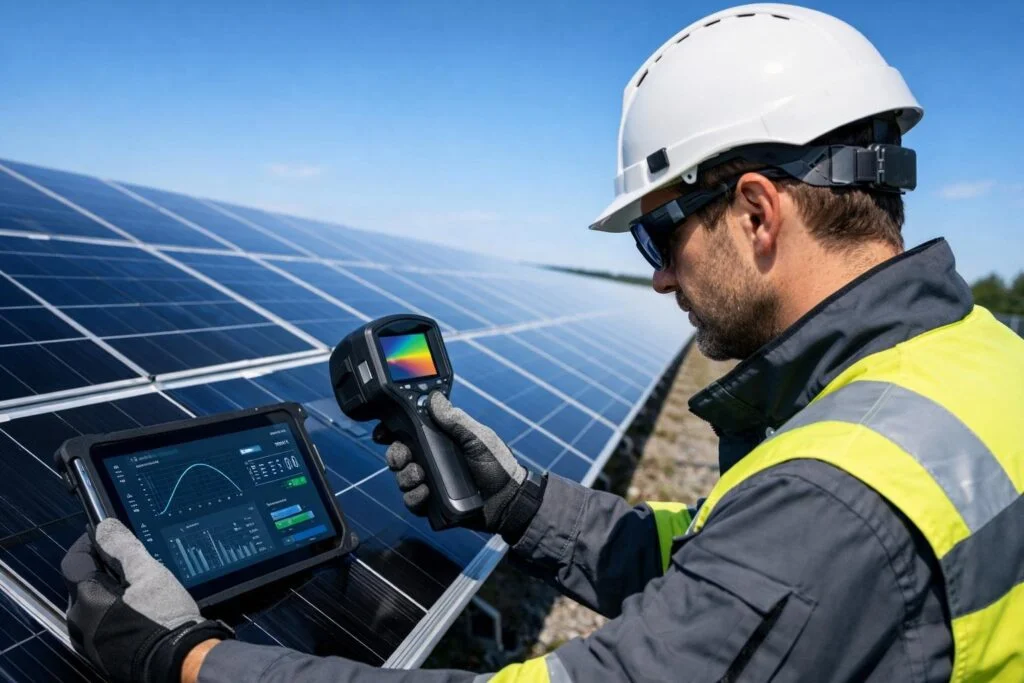
Electroluminescence (EL) testing can spot micro-cracks and cell defects you’d never see with the naked eye. For wholesale solar panel sourcing, this is a must if you care about warranty and long-term performance.
Get EL test reports for your sample batches before you lock in your order. Good suppliers do this at the factory and provide paperwork with serial numbers matching your shipment.
Impacts of Lead Time and Response Time on Global Orders
Production lead times for standard modules usually run 15–25 days after you confirm the order. N-Type TOPCon modules from popular brands may force you to book 4–6 weeks in advance for 2026 delivery.
How fast your supplier replies tells you a lot about their reliability. The pros answer technical questions in 24–48 hours and send you detailed quotes with shipping terms spelled out.
Ocean freight adds another 25–45 days, depending on where you’re shipping. Don’t forget customs clearance, inland transport, and random delays when you’re planning your solar PV procurement timeline.
Container shipping rates bounce up and down with the seasons, so your landed cost can change even if you have an FOB deal.
Navigating the International Solar Panel Supplier Landscape

China’s responsible for about 85% of global solar panel production. Most manufacturers cluster in Jiangsu, Zhejiang, and Guangdong provinces.
If you want to lock in quality and manage supply chain risks, you’ve got to dig into supplier capabilities, production models, and how they verify compliance.
Major Solar Panel Manufacturers and Vertical Integration
Top tier solar manufacturers like JinkoSolar, Trina Solar, JA Solar, LONGi, and Canadian Solar own a big chunk of the market. They’re vertically integrated—handling everything from polysilicon to final module assembly.
Vertically Integrated Tier-1 Manufacturers:
- JinkoSolar – Based in Changzhou, 85+ GW annual capacity, big on TOPCon tech
- LONGi – Top monocrystalline wafer producer, strong in PERC and HJT cells
- Trina Solar – Handles everything from ingots to modules, expanding TOPCon capacity
- JA Solar – Focused on high-efficiency cells, n-type lines
- Canadian Solar – Manufacturing in China, Southeast Asia, and North America
Vertical integration can give you price stability and a more reliable supply. These companies control raw material costs and usually stick to their delivery schedules better than those that just assemble modules.
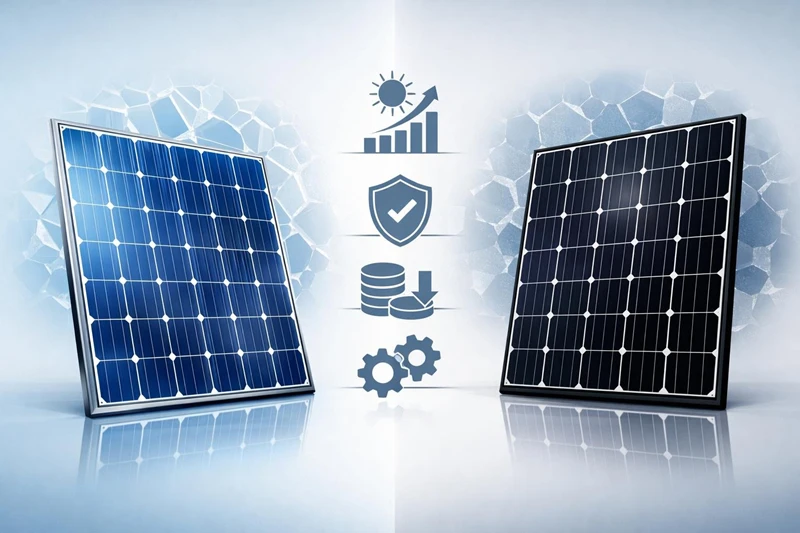
You’ll probably pay a 10–15% premium over mid-tier suppliers, but you get access to the latest cell tech like TOPCon and HJT.
Mid-tier manufacturers often specialize in just one stage—maybe cell production or module assembly with purchased cells. This can mean lower prices if you’re fine with standard PERC modules.
OEM vs ODM Options for Global Buyers
OEM (Original Equipment Manufacturer) deals let you order panels built to your specs, with your brand. ODM (Original Design Manufacturer) partnerships offer pre-designed products you can rebrand—no need to reinvent the wheel.
OEM Benefits:
- Custom specs for power, size, and certifications
- Your branding on modules and packaging
- Custom warranty programs
- MOQs usually start at 500–1,000 units (about one container)
ODM Benefits:
- Lower MOQs—sometimes just 100–200 units
- Faster delivery (4–6 weeks instead of 8–12)
- Lower development costs
- Proven designs with certifications already in place
OEM is the move if you’ve got specific requirements or want to stand out in your market. ODM works if you’re testing the waters or entering a new market and don’t want to commit to a huge custom order.
Most Tier-1 manufacturers prefer OEM for bulk, while mid-tier suppliers tend to be more flexible with ODM.
Factory Audit and Third-Party Inspection Protocols
Factory audits give you a real look at manufacturing capabilities, quality controls, and compliance before you sign a purchase order. Third-party inspection services like Intertek, TÜV, and SGS can independently verify production quality.
Critical Audit Checkpoints:
| Audit Area | What to Verify |
|---|---|
| Production Capacity | Actual output vs. what they claim, equipment age, maintenance records |
| Quality Testing | EL testing gear, IV curve tracers, thermal imaging |
| Certifications | Valid IEC 61215, IEC 61730, UL listings (check expiration dates) |
| Material Traceability | Where they get silicon wafers, supplier docs for EVA/POE |
| Worker Conditions | Labor standards and safety protocols |
Request factory audits 60–90 days before your first order. Third-party inspections should happen at three points: before production (materials check), during production (in-line testing), and before shipment (final inspection).
Intertek and Bureau Veritas typically charge $300–800 per inspection day, depending on your order size.
Pre-shipment inspections catch defects before your panels ship. Inspectors test random samples for power output, check for visual defects like microcracks, and look at packaging. This costs about 0.3–0.5% of your order value, but it’s worth it to avoid costly returns and project delays.
Wholesale Solar Panel Pricing and Volume Strategies for 2026
Volume commitments have a direct impact on your price per watt. Technology choices and trade terms also play big roles in your project’s long-term profitability.
If you understand how N-type TOPCon module price trends and LCOE calculations interact with shipping terms, you’ll be in a much better spot to structure competitive bids.
Current Price Ranges Based on Quantity and Technology
If you move from pallet-level orders to full container commitments, your cost per watt drops a lot. Utility-scale bifacial modules with N-type TOPCon cells usually cost $0.12 to $0.18 per watt for container-level orders in March 2026.
P-type PERC technology still comes in with lower upfront pricing, around $0.10 to $0.14 per watt. The industry’s shifting production to N-type, so finding replacement parts for PERC installations is getting tricky.
Container orders—think 500-700 modules per 40HQ—unlock the best pricing. Pallet quantities cost 15-25% more since distributors have to break up bulk shipments and deal with extra handling.
Technology pricing breakdown:
- N-type TOPCon bifacial: $0.12-$0.18/W (container)
- P-type PERC mono: $0.10-$0.14/W (container)
- HJT premium modules: $0.19-$0.24/W (container)
Wholesale solar panel costs reflect raw material stability. Q1 2026 solar module prices are climbing because higher silver prices are hitting cell manufacturers.
Balancing LCOE, Quality, and Trade Terms
LCOE calculations show the real cost difference between technologies over a 25-year project. N-type modules degrade at about 0.4% per year after the first year, while standard PERC panels lose 0.5-0.7% annually.
Your quoted FOB price doesn’t include ocean freight, insurance, port fees, or import duties. If you choose CIF pricing, shipping and insurance to your destination port are included, which makes landed cost calculations less of a headache.
Critical LCOE factors:
- Degradation rates: Lower annual losses directly improve energy yield
- Temperature coefficients: Better performance in hot climates increases actual kWh production
- Bypass diodes: Quality diodes minimize shading losses and hotspot formation
Grade A certification means your solar panels hit manufacturer specs for efficiency and visual quality. Buying from authorized distributors protects your warranty, which really matters if you’re seeking project financing.
Utility-Scale, Commercial, and BIPV Project Sourcing
Utility-scale projects need megawatt-level volumes. Even a $0.01/W price change can swing your total capital costs by a lot.
Your sourcing strategy should focus on manufacturers with proven gigawatt-scale output and steady supply chains. Commercial installations need flexible delivery and often mix container options.
Rooftop projects might combine different wattages or form factors in one shipment to fit various roof sections. Building-integrated PV (BIPV) projects need aesthetic consistency and architectural certifications that standard solar panels simply don’t have.
BIPV modules cost more ($0.30-$0.50/W) because of customization and smaller runs. Strategic sourcing of solar PV panels means knowing how your project type shapes minimum order quantities and trade terms.
Risk Mitigation, Compliance, and Logistics in Global Solar Sourcing
Global solar procurement in 2026 takes careful attention to financial stability, product certifications, and secure payment structures. Transportation headaches and component compatibility add complexity, so you’ll want to plan ahead.
Supply Chain Risk and Bankability
Your supplier’s financial health can make or break your project. A manufacturer might offer great pricing, but if they leave the market in two years, your warranty’s gone.
Look for vertically integrated solar manufacturers who control everything from raw materials to final assembly. This setup usually means better cost control and quality. Ask for financial statements and check that they serve diverse customers in multiple markets.
The market’s consolidating. Mid-tier manufacturers without strong finances are dropping out.
Check that your supplier has non-recourse financing from international banks—this signals that creditors trust their stability.
Certifications: IEC 61215, PID, Quality Standards
IEC 61215 certification is the baseline for crystalline silicon modules. This standard tests modules under stress like thermal cycling, humidity, and mechanical loads.
Potential induced degradation (PID) testing really matters for your long-term energy yield. PID happens when voltage between cells and the grounded frame causes power loss over time.
Quality modules should show PID resistance below 5% power loss after 96 hours at 85°C and 85% humidity. SGS testing reports give independent proof of manufacturing quality.
Don’t just trust factory datasheets. Ask for third-party test results on electrical performance, mechanical durability, and safety.
Key certifications to verify:
- IEC 61215 (design qualification)
- IEC 61730 (safety qualification)
- PID test reports (less than 5% degradation)
- SGS factory audit certification
- Country-specific marks (CE, UL, TUV)
Distributors, EPCs, and Escrow Services in International Deals
Working with established distributors cuts procurement risk compared to going direct to the factory. Distributors keep local inventory, handle warranty claims, and offer technical support in your region.
EPC contractors often have preferred supplier relationships that make your project smoother. They know customs clearance, quality inspection, and logistics compliance rules for different countries.
Escrow arrangements protect both sides in big deals. The payment only releases once you verify product quality through independent inspection.
This is especially important for orders over $500,000 where financial exposure gets serious.
Mounting Systems and Integrated Inverter Procurement
Your mounting systems have to match your panel dimensions and weight. If your racking doesn’t fit, you’ll face installation delays or even structural failures.
Source mounting hardware from companies that provide engineering calculations for wind and snow load in your location. Generic solutions often fail local building codes.
Inverter compatibility takes careful attention to voltage windows and max power point tracking. Your modules’ electrical specs need to line up with your inverter’s input across all temps.
If you buy both components from coordinated suppliers, you avoid compatibility headaches and warranty disputes if system-level issues pop up.
Frequently Asked Questions
Most wholesale solar panel orders in 2026 start at 5-20 kilowatts. Premium technologies usually require larger commitments.
Payment structures reward higher volumes with 15-30% discounts. Import logistics tack on $0.02-0.05 per watt in shipping costs depending on where you’re sending them.
What is the typical minimum order quantity for wholesale solar panels in 2026, and how does it vary by manufacturer and region?
Standard MOQ requirements run from 1 kilowatt to 20 kilowatts, depending on the supplier’s scale and market. Small-batch manufacturers start at 100 pieces with 15-25 day delivery if you’re testing out new products.
Chinese manufacturers in Anhui and Guangdong usually want 5-10 kilowatts for standard monocrystalline modules. Suppliers in Guangdong with export-focused setups may accept lower MOQs of 1-5 kilowatts for international distributors entering new markets.
Southeast Asian factories in Vietnam and Malaysia tend to keep higher thresholds, like 10-20 kilowatts. They need bigger orders to cover higher labor costs than their Chinese rivals.
How do MOQ requirements differ between standard, high-efficiency, bifacial, and n-type modules for B2B orders?
Standard monocrystalline PERC panels have the lowest MOQs—5-10 kilowatts—thanks to widespread production. High-efficiency modules above 22% efficiency usually require 10-15 kilowatt minimums since fewer factories make them.
Bifacial modules with dual-sided energy capture need 15-20 kilowatt orders because they’re more specialized. N-type tech, including TOPCon and HJT, calls for even higher commitments—20-50 kilowatts—since production lines are limited.
Custom solar panel manufacturers might negotiate lower minimums if you’re okay with longer lead times. Advanced tech commands higher pricing, so manufacturers offset that with bigger batch requirements.
What pricing breaks and payment terms are commonly tied to MOQ tiers in global solar panel sourcing?
Entry-level orders at 5-10 kilowatts usually cost $0.18-0.22 per watt for standard modules. Volume discounts of 5-8% kick in at 50-100 kilowatts, dropping costs to $0.17-0.20 per watt.
Wholesale pricing in 2026 depends on panel efficiency, supplier discounts, transport costs, and bundled gear like inverters and racking. Orders over 500 kilowatts can save you 15-20% versus baseline pricing.
Payment structures often require 30% deposits and the rest before shipment for first-time buyers. Established customers with a solid payment history can usually get net-30 or net-60 terms.
Which certifications and compliance documents should global buyers require before placing a bulk order?
You need to verify that suppliers hold IEC 61215 and IEC 61730 certifications for module design and safety. UL 1703 is mandatory for North America, and CE marking is a must for EU imports.
ISO 9001 certification shows the factory’s got systematic production controls. TÜV Rheinland and SGS third-party audit reports confirm factory size, automation, and real production capacity—not just what’s claimed in marketing.
Ask for full technical datasheets with NOCT ratings, temperature coefficients, and annual degradation rates below 0.55%. PID resistance and mechanical load certifications show the panels will last in tough climates.
Material traceability proves where the silicon wafers came from and avoids conflict minerals or restricted regions. Warranties should cover 10-12 years for manufacturing defects and 25+ years for performance guarantees.
How should buyers evaluate factory capacity, lead times, and quality-control processes when ordering at MOQ scale?
It’s smart to ask for third-party audit reports from Bureau Veritas or SGS. These confirm the factory’s monthly output volumes.
Take a close look at the automation levels in cell stringing, lamination, and framing stations. This gives you a sense of how consistent and scalable the production really is.
For MOQ orders, standard lead times usually fall between 15 and 45 days. If you want custom specs like branded backsheets or a certain junction box placement, expect another 10 to 20 days added to the timeline.
Quality control should include electroluminescence testing to catch microcracks. Visual inspections at different production stages are just as important.
Order a sample batch and send it out for independent lab tests—check for things like mechanical load resistance, damp heat exposure, and how well the modules handle hail. You want to know what you’re getting before committing to a full order.
Try to visit the factory, even virtually. You’ll get a real sense of their cleanliness standards, soldering quality, and how well they’ve trained their workers.
Ideally, the factory’s monthly output should be at least 50% higher than your order. That way, they can handle any rush jobs or unexpected increases without breaking a sweat.
What are the key shipping, insurance, and import considerations for container-load solar panel purchases across borders?
Standard 40-foot high-cube containers fit about 500 to 700 panels. The exact number depends on the wattage and how tightly they’re packed.
With FOB pricing, you take responsibility once the modules leave the factory. CIF terms, on the other hand, cover cost, insurance, and freight right up to your destination port.
Wholesale buyers should set aside around $0.02 to $0.05 per watt for international shipping. This range shifts with distance and those ever-changing fuel surcharges.
Marine cargo insurance usually runs 0.3% to 0.5% of the total shipment value. It protects you if the panels get damaged on the way.
Import duties jump around a lot depending on where you’re shipping from and where you’re headed. U.S. importers deal with Section 201 tariffs and sometimes anti-dumping duties, while the EU slaps on standard customs rates plus VAT.
Double-check harmonized tariff codes and current trade policies before you pick a supplier. Rising tariffs and manufacturing rule changes in 2026 have already bumped up landed costs by 10-15% compared to what folks paid before.